Showing posts with label pedagogy. Show all posts

Wednesday, February 6, 2019

Lastest Wabash Center Article on #LearningOnline in Theological Education

You can read the article online or download a PDF version here

Well, I have not been doing much posting on the blog (just way way toooooo busy) but I have been slowly working on publishing steadily again, starting with the Wabash Center's series on Online Teaching-Learning, then working on some lectionary articles with the Westminster  John Knox Press Series Connections (Lectionary B), and eventually going full steam to finish a long overdue monograph with Mohr-Siebeck. 
   For now, I hope those interested in online education will find this article helpful on "5 Tips for Effective Online Teacher-Student Communication" born from trial and error, mostly error, and learning to be a better teacher in the process. 

Saturday, November 24, 2018

G(r)eeking out over Online Tech Tools

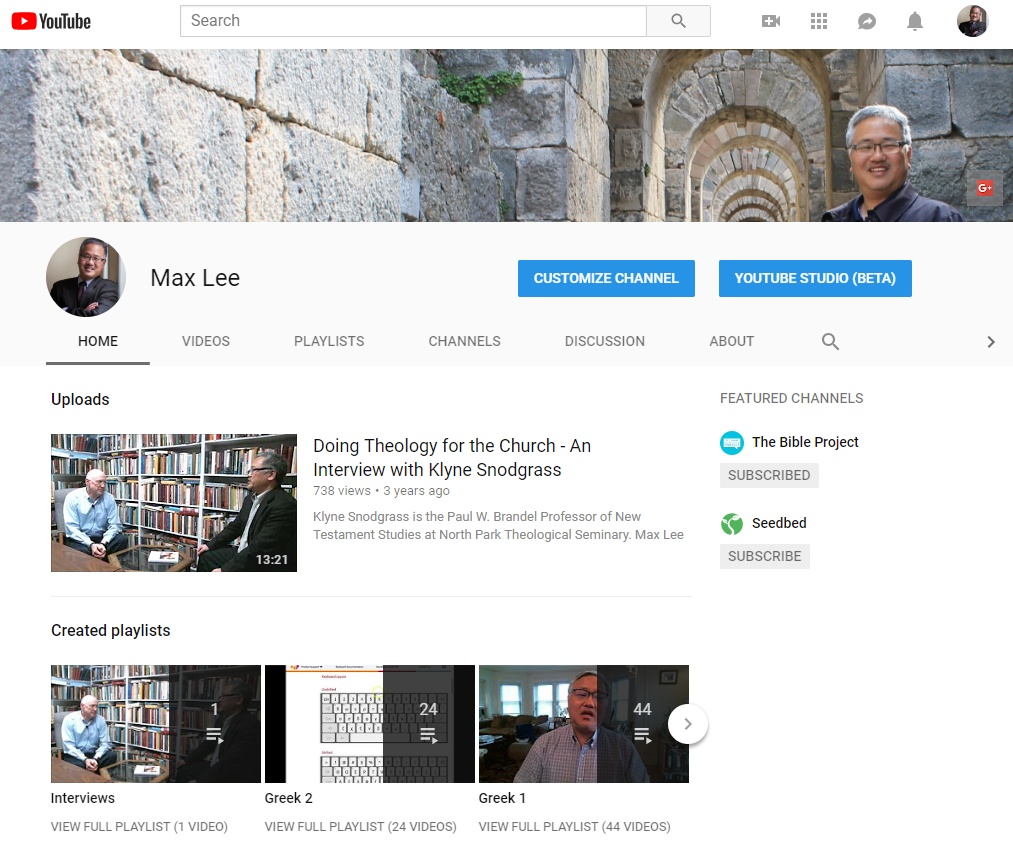
My YouTube channel where I post all my instructional videos
It's been a whirl-wind couple of weeks culminating at SBL-AAR 2018, enjoying Thanksgiving, and getting back to work on grading and teaching. I wish I had more time to reflect on the SBL conference and the sessions that I heard but I think I'm just going to have to plunge into the end of the Fall semester since the final exams are coming around the corner in a few weeks. 
    That said, it was nice to see my 2nd blog post published at the Wabash Center for Teaching Theology and Religion as part of their ongoing series in online education. In the 2nd blog article, I write on the tech tools necessary for the would-be course designer and instructor to teach biblical languages online, focusing on the current course I'm teaching at North Park. The technology is available and affordable to teach beginning Greek (and Hebrew) well and effectively for today's online learning community. If you're curious, check out my blog article entitled: "G(r)eeking out over Online Tech Tools" here.
    Blessings as we head into Advent in one week's time. MJL

Saturday, June 2, 2018

For Teachers Everywhere

I and my sons are big Golden State Warriors fans, since I was born in San Francisco, raised in the East Bay, and brainwashed my boys to love California teams over Chicago. It was a rough start for Game 1 of the 2018 NBA Finals but #30 helped pull out the win. Cleveland made a crucial mistake in the last seconds of play that could have ended the regular game time with their win, not Oakland's. I made a meme of the infamous episode in honor of all professors and teachers in education who know how the following feels:

Best! MJL

Saturday, January 17, 2015

Movie Review: Apostle Paul - A Polite Bribe by Robert Orlando

I'm glad that I can get back to blogging. I was taken aback by how busy the 1st week of the Spring 2015 term was and missed already my aim to post regularly at least once a week here. Hopefully, I can get back on track, though I make no promises (note: posting 1x a week was not a new year's resolution!). I am teaching 4 classes this semester, and if I include a co-taught course on Reconciliation, Race and the Corinthian Correspondence with Paul De Neui (North Park's missiologist) in May (a 2-week mission trip to the Equateur province of Congo), that's a whopping 5 courses that I need to prep and teach. Ouch! But I'm all-in and ready to charge out of the gates with gusto as far as human agency, divine help, and prayer can take me. 
Purchase or rent the movie at amazon instant video
A preview/promo of the film can be watched here: 


   That said, I have been meaning to watch and review the recent documentary on the apostle Paul with the provocative title: Apostle Paul - A Polite Bribe (2014). I finally watched this and like it enough that I am currently requiring that my undergraduate Paul course and my seminary New Testament 2 class view the film. Their research project will involve an engagement with Orlando's central thesis on the purposes and motivations of Paul to collect, transport, and deliver an offering to the church in Jerusalem (mentioned explicitly by Paul in 1 Cor 16:1-4; 2 Cor 8:1-9:15; Rom 15:25-32; and likely Gal 2:1-10 though Bruce Longenecker would argue otherwise; and recorded by Luke in Acts 11:27-30 [famine impetus]; 21:17-26 [delivery of the collection]). 
    Orlando, if I did not miss anyone, interviews some 24 different New Testament scholars on the life and mission of Paul, using the Jerusalem collection as a kind of thematic thread to unite the interviews and illustrated narrations (using some impressive comic-motion style graphics) that reconstruct the historical Paul of Acts and his letters. It's a relative who's who of top names in the academy on Pauline studies, including (roughly in order of their 1st appearance): Paul Achtemeier, Ben Witherington, Candida Moss, Bart Ehrman, N.T. Wright, John Dominic Crossan, Jeffrey Bütz, Philip Eisler, Gerd Thiessen, Paula Fredriksen, Pamela Eisenbawn, Larry Hurtado, Neil Elliott, Elaine Pagels, Richard Horsley, Amy-Jill Levine, Robert Jewett, Troels Engberg-Pedersen, Dale Martin, John Reumann, Douglas Campbell, Victor Furnish, Daniel Boyarin and Edgar Krentz. Whew... did I miss anyone?
    Just to hear in person the above scholars offer their expertise on Paul is worth the price of admission. They together represent a wide range of confessional, ecclesial, and ideological commitments which range from conservative evangelical scholars to radical source critics. You get the whole spectrum. But while a range is represented by the choice of interviewees, and while the critical listener can glean from these interviews diverse and competing theories on Paul's missionary enterprises, the interviews themselves have been expertedly edited to promote one central thesis: that Paul's monetary offering functioned as some sort of "bribe" to assuage suspicions from a hard-line faction in Jerusalem (= the Judaizers of Gal 1-2) who did not consider Paul's Gentile churches full converts to Jewish-Christianity. How the offering functioned as a bribe was not clear in the film. Perhaps, Paul hoped that the acceptance of the offering by the Gentile converts by the famine-stricken Jerusalem church would also mean that the Jerusalem church accepted the donors as full members of God's people without the Jewish requirements of circumcision and food law observance. If so, this meant that Paul paid Jerusalem to by-pass the Jewish legal requirements and hence the subtitle, "a polite bribe." 
   However, if one simply reads the key texts in Paul (cited above) where he explains his own motivations for asking the Gentile churches to contribute to the Jersusalem collection, we read that 1) his Gentile churches could have simply wanted to help the poor in Jerusalem who were recovering from a horrible famine (mentioned in Acts 11:27-30) as a sign of their transformed lives and genuine conversion; or 2) the collection demonstrated that there was one church, Jewish and Gentile, united by their common fidelity to one Lord and one gospel, and so the needs of one were the concern and burden of the other; or 3) perhaps Paul saw in the collection an eschatological fulfillment of Isaiah (60:6-7) and other OT prophetic texts (cf. Micah 4:13) that promised a day when Gentiles would bring gifts to Jerusalem as an act of worship and recognition of Israel's one true God. There have been other suggestions by scholars like Klaus Berger that 4) the collection functioned to substitute for the cost of Jewish initiation rites required from Gentile converts to Judaism (a stretch in my opinion). Johannes Munck theorized that 5) Paul wanted the collection to draw Israel's attention to how the influx of Gentile converts into the church and somehow provoke Israel's jealousy and conversion to the gospel (less of a stretch, but still a stretch). This list of possible explanations is not exhaustive either. There could also be a non-competing coalition of several motivations that drive Paul to pursue the collection and deliver it (see Down's The Offering of the Gentiles). But the movie, unfortunately, really focuses on the idea of a polite bribe.
   So in the end, Orlando's thesis is not satisfying, and it creates more questions than answers. But the latter is not a bad result. In fact, his film is a fantastic segue into larger historical issues surrounding Paul and hence my keen interest to show the film in class and let it generate further discussion. 
   A number of other bibliobloggers share my same sentiments and evalution of the film, in varying degrees. Worth reading are the posts by Larry Hurtado, James McGrath, and Richard Fellows. Also check out the interview of Ben Witherington in the Lexington Herald, as well as his video question and answer session after a film viewing. Mark Goodacre posted a pre-showing interview with Orlando on his NT blog as well. 

Post-script 03/11/15: Here is a link to the post-screening discussion which took place over the film at the SBL showing in San Diego on Nov 22, 2014 between the director Robert Orlando, and scholars Larry Hurtado and Ben Witherington. 

Friday, June 13, 2014

Déjà vu... Teaching Undergraduates Again

In case anyone is wondering why I'm adding some post-script assignments to select blog posts, well, I'm slotted to teach an undergraduate class for the Biblical and Theological Studies Department at North Park University this coming Fall. I'm still keeping my day job as full-time seminary faculty, but since Scot McKnight's departure for Northern, the undergrad wing of the university's BTS dept. has been short-staffed. I'm happy to help out and relive my days as an college professor (3 years at Wheaton College and 1 year at Westmont) here at NPU. But it has been 8 years since my undergraduate teaching experience, so hopefully I can get up to speed very quickly.
Teaching at the seminary (left photo) and
Anticipating teaching at undergrad again (right photo)
   I thought it would be good to integrate this biblioblog with my Paul course. I have set up several exegetical exercises for NPU (and may be later seminary?) students under the label/tags "exegetical exercises." My hope is that the more I blog, the more posts I can use for pedagogical purposes. And if everything goes well, my students will have a blast using the resources on Paul Redux. We shall see. 
   FYI, the above left photo is from my cozy seminary course on intercultural readings of the Bible. On the right is a photo from my days teaching at Wheaton College (I'm preaching at the senior graduation chapel). I anticipate the class size to be much larger among the undergrads. It will take an adjustment on my part but I'm eager to (re)connect with a younger generation of motivated minds and hearts.