Showing posts with label museum. Show all posts

Monday, May 22, 2017

Warning Sign to Greeks on the Temple Mount

It feels like a long time since my Turkey trip in March 2017. I took about 6500 photos from my study tour through Turkey. A big shout-out to Dr. Mark Wilson who was an amazing commentator for connecting the archaeology and landscape of the sites I visited with the history of early Christianity in Asia Minor. Many thanks also to Tuktu Tours who organized the trip (as safe as safe could be!) and Meltem Ciftci, our official tour guide. 
    This post is on the Istanbul National Museum because I was able to finally connect one archaeological find in the Israel Museum, of which I took photos back in April 2016, to another artefact housed in Istanbul. First is the inscription from the Israel National Museum which was found near the Lion's Gate of old Jerusalem: 
Greek Temple Mount Warning (Israel Museum)
Photo by Max Lee ©2016
This small inscription currently housed in Jerusalem is so fragmentary, it's hard to figure out what it might say. None of what you see is a full word except for a random article (τοῦ) or conjunction (καί). Here is the inscription again in transcribed form: 
  • ΘΕΝΑΑΛΛ
  • ΤΟΣΤΟΥΠ
  • ΤΟΥΚΑΙ
  • ΗΦΘΗΑΥ
  • ΙΑΤΟΕΞ
  • ΘΑΝΑΤ
Josephus writes about a series of stone slabs that give warnings to foreigners, some written in Greek, others Latin, that no foreigner was permitted to enter the Temple area (see Jewish Wars 5.194). Scholars rightly identify the above inscription as an example of this warning. 
     But the identification is only possible because we can compare it to a larger and more complete warning which was found north of the Temple Mount and is currently housed at the Istanbul National Museum (how a fragment unearthed at the Temple Mount finds its way to Istanbul is another story). 
     Surprisingly, unlike the smaller one above that was protected in a (fiber)glass casing in prominent display, this larger and arguably more important find was on the floor of the Istanbul Museum, sandwiched obscurely between two other displays, without any protection, and vulnerable to the goodwill of any observer who walks by it. It was a first for me to be so close to, and able to touch, an inscription of such importance. 
Companion and More Complete Inscription of the Greek Temple Warning
1st century C.E., located at the Istanbul National Museum
Photo by Max Lee ©2017
As you can see, the larger inscription is likely complete. For comparison, you can see where the lettering preserved in the 1st inscription (red font) is repeated in its 2nd companion copy: 
  • MHΘΕΝΑΑΛΛΟΓΕΝΗΕΙΣΠΟ
  • ΡΕΥΕΣΘΑΙΕΝΤΟΣΤΟΥΠΕ
  • PΙΤΟΙΕΡΟΝΤΡΥΦΑΚΤΟΥΚΑΙ
  • ΠΕΡΙΒΟΛΟΥΟΣΔΑΝΛΗ
  • ΦΘΗΕΑΥΤΩΙΑΙΤΙΟΣΕΣ
  • ΤΑΙΔΙΑΤΟΕΞΑΚΟΛΟΥ
  • ΘΕΙΝΘΑΝΑΤΟΝ
Put the inscription in cursive text with an English translation, and it reads: 

μηθένα ἀλλογενῆ εἰσπο|ρεύσθαι ἐντὸς τοῦ πε|ρὶ τὸ ἱερον τρυφάκτου καὶ | περιβόλου. ὅς δ' ἂν ληφθῇ ἑαυτῷ αἴτιος ἔσ|ται διὰ τὸ ἐξακολου|θεῖν θάνατον

No foreigner is to enter within the balustrade and enclosed area surrounding the Temple. And whosoever is caught will himself be responsible for his resultant death

With this full inscription from the 2nd artefact, we can now reconstruct what the 1st smaller inscription must have looked like as a companion copy of the same warning. Below is an artists's reconstruction of the 1st inscription in its entirety as the script is extrapolated from the original piece (traced out below).
Diagram from Corpus Inscriptionum Iudaeae Palestinae (vol. 1, pt 1; p. 43)
As Josephus stated ("In this [balustrade] at regular intervals stood slabs giving warning, some in Greek, others in Latin characters, of the law of purification, to wit that no foreigner was permitted to enter the holy place, for so the second enclosure of the temple was called" J.W. 5.194; LCL, p. 61), there were several such warning signs all over the temple area. Luckily, we have at least two of them. 
     The signs give a historical context to several texts in the New Testament, including the scene in Acts where some pious Jews thought Paul had brought a Gentile, Trophimus the Ephesian (Acts 21:29), into the temple, and started a riot as a result. There is also Paul's reference to the temple's physical walls separating out the court of the men from foreigners in the Letter to the Ephesians. Here he uses it as a metaphor for how this "dividing wall of hostility" between Jews and Gentiles has been torn down by the work of Christ (e.g., Eph. 2:14). 

Sunday, February 14, 2016

Paul's Use of Precious Metals to Describe Pastoral Ministry in 1 Cor 3:11-15

It just so happens that the antiquities exhibit at the Getty Villa affords an opportunity to give a photo-by-photo commentary on Apostle Paul's use of precious materials to describe the building blocks of pastoral ministry. The text I'm thinking about is 1 Corinthians 3:11-15 (my own translation below): 

11 For no one can lay a foundation beyond what has been laid, which is Christ Jesus. 12 And if anyone on this foundation builds with gold (χρυσόν), silver (ἄργυρον), precious stones (λίθους τιμίους), wood (ξύλα), grass (χόρτον), stubble (καλάμην), 13 the work of each person will become apparent, for the day will make it clear, since it will be revealed by fire and fire will test (τὸ πῦρ δοκιμάσει) one's work, the quality of each (ἑκάστου τὸ ἔργον ὁποῖόν). 14 If the work which someone built remains (μενεῖ), the person will receive a reward. 15 If one’s work is burnt up, the person will experience loss (or "will be punished," depending on how you translate ζημιωθήσεται), but he himself will be saved, but in the same way as [one gets] through fire.  (1 Cor 3:11-15)

The Getty Villa had a special Roman silver exhibit they procured from France (the Berthouville Treasure discovered in 1830) back in summer 2015, but unfortunately, the museum was very strict about not allowing any photos. I was tempted to sneak a few pic's but chickened out. 
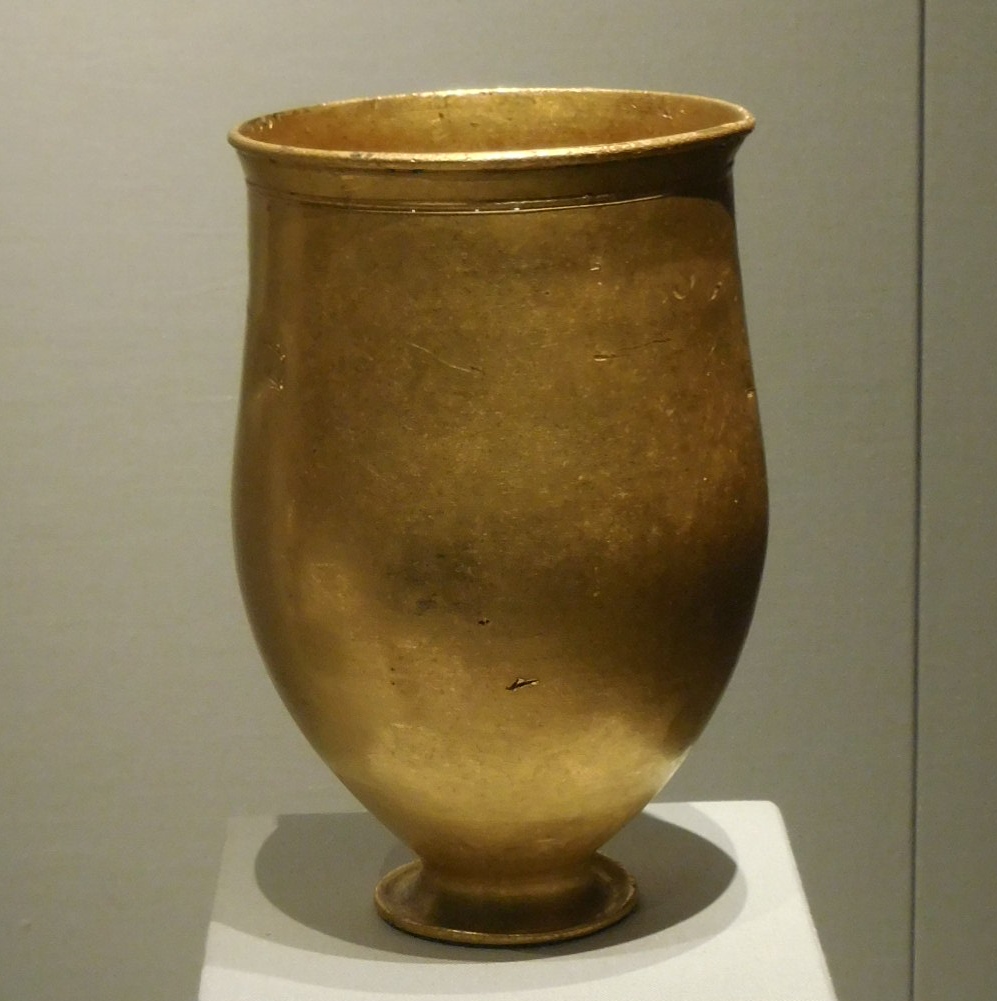
    Much more modest but still helpful was the Villa's own precious metals artefacts exhibit (mostly focusing on silver items but some gold) with a fair sampling of ancient jewelry, and these I could take photos of. They provide a nice way to illustrate the first three items mentioned in Paul's list of building materials. I've included these below with identifying tags from my visit to the Villa last summer.

Roman gold cup (gold weight = 2 libras; ca. AD 1-100)
from Knidos (Turkey)
Photo by Max Lee © 2015 Getty Villa
Greek silver wine cups (ca. 100-50 BC)
Photo by Max Lee © 2015 Getty Villa
Parthian necklace with detached pieces of
sardonyx stones as jewelry (ca. 100BC)
Photo by Max Lee © 2015 Getty Villa
Mummy Mask of a wealthy woman in Roman Egypt (ca. AD. 100)
(more on mummy masks here). Look closely around her neck and
you can see the bottom necklace composed of precious stones
Photo by Max Lee © 2015 Getty Villa
Paul in this text appears to highlight two points of comparision between the first group of gold, silver, and precious stones versus the second group of inferior building materials such as wood, grass, and stubble. He charges the church in its ministerial practices, what kind of building or body of believers are they constructing? 
    If fire here stands for divine judgment, or a metonymy for the eschatological judgment of God at our Lord's return, God tests our ministry both for 1) the quality or kind (ὁποῖόν) of work we do, and 2) whether the work remains or lasts (μενεῖ). The museum exhibits are a nice reminder that articles of gold, silver, and precious stones stand the test of time and endured to be discovered later. While there are unusual exceptions where articles of wood have been preserved (e.g., the 2000-year old fishing boat found on the bottom of the Sea of Galilee during a drought), for the most part, things built of wood, grass/hay, and stubble do not stand the test of time. They do not remain (μενεῖ) or last. 
    Pastorally, Paul's injunctions in 1 Cor 3 remind me never to present the gospel cheaply. If a preacher waters down the gospel and reduces Jesus' demand for complete surrender to something less, and this is what a person commits him- or herself to, then how watered down can the gospel be before it is no longer salvation to the one who receives it? Will such a person's salvation stand the test of present trials and persecution, let alone God's own judgment at the end of time? 
    Or, on another note, will the church I pastor stand strong until the Lord's return? What kind of disciples am I raising so that they can take the baton of faith and pass it on to a new and vibrant generation of Christian followers rising amongst our ranks? 
    The exhortations by Paul are sobering both theologically and pastorally. And the vividness of what lasts became even more colorfully illustrated by the artefacts at Getty.

Monday, February 8, 2016

Once Again the Brutality of Ancient Boxing: Lessons from the Getty Villa Museum

It's back to business and the main focus of this blog: interpreting the Apostle Paul in his Greco-Roman context. In the past, I had done a series of posts on athleticism in the Mediterranean world during the early imperial period of Rome. But when I was visiting the Getty Villa last summer, I came across a stunning mosaic from the Gallo-Roman period discovered in the archaeological ruins of a Roman villa in present-day Villelaure, France. I thought it worth discussing the boxing scene depicted in this mosaic floor made of stone and glass:
Roman Mosaic of two Boxers (ca. A.D. 175)
Photo by Max Lee © 2015 from the Getty Villa
In the above photo, we have the artist's depiction of the aged Sicilian boxing champ Entellus (left) and the younger Trojan hero Dares (right) who is bleeding from a wound inflicted by Entellus. In the background is the prize bull for the winner (no-brainer: Entellus won!) which, according to Virgil's Aeneid, was punched so hard by Entellus, he cracked the bull's skull and killed it as a sacrifice to the gods. 
    Even more interesting is how both boxers wear caesti or leather gloves, often wrapped with iron balls or lead around the boxers' hands to increase the force of the blows. It goes without saying that such blows could prove fatal in the ring.
    The mosaic is a shocking reminder that boxing was brutal in the ancient world, and the athlete who engages in it required focus, stamina, discipline, training and endurance. Ancient boxers made modern MMA fighters look like wimps. 
    Therefore it is all the more striking (pardon the pun!) how the Apostle Paul uses the boxing metaphor to describe the discipline and focus needed in ministry: 

25 Every competitor/athlete (ὁ ἀγωνιζόμενος) exercises self-control over all things; they do this to receive a perishable wreath, but we an imperishable one. 26 So I do not run aimlessly, nor do I box (πυκτεύω) as though beating the air; 27 but I punish my body and enslave it, so that after I proclaim (κηρύξας) [the gospel] to others, I myself shall not become disqualified. (1 Cor 9:25-27)

The minister is the spiritual athlete. The one who proclaims the gospel to others and learns to become all things to all people so that by all means he or she might save some (cf. 9:22) requires the focus and precision of an expert boxer who disciplines one's own body and trains it, but also stays on mission without distraction. Everyone who preaches the gospel knows that ministry can be more brutal than boxing.

Sunday, October 18, 2015

Recovering Papyri Fragments from the Wrappings of Mummy Masks

Cartonnage bath to separate out the used papyri from a mummy mask
Photo taken from Emily Teeter's Ancient Egypt (2003)
Prior to my post on the Symposium on the Theological Interpretation of Scripture, I wrote on the mummy masks that were on display at the Getta Villa (see this post). It just so happens that last year, mummy masks were all the rave because of the possibility that some Gospel of Mark fragments dated to the late 1st century A.D. were recovered from the cartonnage (an ancient version of paper mâché made of linnen or papyri strips with glue) of a mummy mask. The claim has stirred up quite a bit of controversy and intense discussion on the blogosphere because the said Mark fragments have yet to be published (the projected 2015 date will probably be missed). Here is a random sampling of scholars who all argue for a healthy dose of scepticism until evidence/data that can be examined by the academic community becomes available: Roberta Mazza, Peter Willliams, James Tabor, to name a few.
    The claims for authenticity, however, should not be ignored because we do have two credible New Testament scholars, highly respected, who insist that the fragments are genuine and it is only a matter of time before they will be published (Brill will publish the fragments as part of the Green Scholars Initiative: Papyri Series; Michael Holmes, Director of the Green Initiative, has released this (un)official statement on his blog). Both Professor of Craig Evans, formerly the Payzant Distinguished Professor of New Testament at Acadia Divinity College, who this past June 2015 recently accepted a new post at Houston Baptist University, and Professor Daniel Wallace of Dallas Theological Seminary and known textual-criticism expert, are eager to answer critics once the papyri have been published. Apparently a non-disclosure statement with the owners of the mummy mask from which the papyri were extracted keeps Evans and Wallace from saying any more. The hornet's nest was stirred when Evans, back in 2014, made this announcement during a lecture (see below): 
Almost immediately, the news media picked up on the announcement and posted articles from it and from an earlier press leak by Daniel Wallace during a debate with Bart Ehrman in 2012 (see Forbes, Live Science, The Smithsonian, The Washington Post, and the Christian Today). 
   I personally will simply wait until the Brill publication becomes available before making my own deliberation on the authenticity of the fragments. There is really nothing more anyone can do until they are published. But pedagogically, the whole process is a great segue to sharing with seminary students how some of our manuscripts and papyri fragments have fascinating stories of their own about their discovery. Aside from the incidental coincidence that mummy masks fit the October halloween theme, the anticipation concerning the Gospel of Mark fragments is a good way to talk about how papyri discoveries come from the oddest places: the garbage dumps of Egypt (think Oxyrhychus), on palimpsest (another form of recycled papyri), Christian monasteries (think Bodmer), or on the antiquities black market. 
    In the case of the mummy mask, with all the secrecy, I suspect that a private collector is involved (but this is only speculation). While we wait for Brill to publish the Green Scholars Initiative papyri series, below is a helpful video which outlines the process that some archaeologists / papyrologists used to protect the painted portrait of the mummy mask while still being able to extract the cartonnage and separate its layers to read the recycled papyri. Have fun! 
Video of Jaakko Frösén (University of Helsinki)
demonstrating how to extract the papyri from a mummy mask
without damaging the painted portrait

One more photo: Life Science has a nice article how renowned classicist Dirk Obbink discovered two poems of Sappho from the mummy cartonnage of a private collector. You can read the article (here). Below is the photo of the recovered papyrus scroll fragment from the cartonnage. Wow! It's amazing that it could be restored with such clarity.
Photo credit: livescience.com
Postscript 10/19/15: One of Roberta Mazza's students found this video on the mummy mask from which the Gospel of Mark fragments came (or at least, this was the mummy mask used on the powerpoint screen for the announcement). If this is indeed the mummy mask, and I'm no expert, it sure makes even me nervous how the mask and papyri was handled. Watching the video can be nerve-wracking as you see the masked and papyri handled by several people. I hope the Green Scholars Initiative is taking care of the papyri well, and the faster Brill publishes it, the better. MJL

Saturday, September 19, 2015

Mummy Masks and Roman Egyptians

One of the best exhibits at the Getty Villa was the display of mummy masks from Roman Egypt. The use of portaits painted on the head of a mummy is a combination of Egyptian burial customs and Roman individualized portraiture traditions. Often wood panels are used for the portrait and later inserted into the mummy's linen wrappings. Pigments were suspended in bee's wax and brushes used to paint the face of the dead onto the panel. Sometimes a hardening agent like eggs yolk was applied. 
   Besides the excellent example of the mummy mask shown in my previous post, here are some of the other mummy portraits on display at the Villa (forgive some glares; I did my best to try to get a clean photo through the protective glass of the display):
Portrait of a Roman-Egyptian Man (AD 200-25)
Cropped hairstyle reflects the Severan era
Photo by Max Lee © 2015
Portrait of an Roman-Egyptian Woman  (AD 170-200)
Dress, jewelry, and hairstyle depict a matriarch of wealth
Photo by Max Lee © 2015
Portrait of a Roman Egyptian Man (AD 200-50)
holding a glass of wine and garland of flowers which
are typically associated with funeral rites
Photo by Max Lee © 2015
Rarely does one find a perfectly preserved mummy in antiquity, but the Getta Villa has one on display which shows nicely how the wood panel portraits like above were inserted in the wrappings of the mummy. Below is the mummy of the Roman Egyptian Herakleides (AD 50-100): 
Mummy Body of the Roman Egyptian Herakleides (AD 50-100)
Photo by Max Lee © 2015
Photo shows how the mummy portrait panel was inserted in the wrappings
and the body itself was decorated further with symbols of protection and rebirth
Photo by Max Lee © 2015
We are not exactly sure why the Egyptians created headmasks (often gold) which later evolved into the Roman practice of life-like portraits on wood panels inserted on top of the head coverings. But it may be that the spirit of the person was believed to be wandering around during the day and in order to return to its body at night, the portrait was there to help the human spirit recognize its own body.
     Also worth noting is how the name of the man was written in Greek just above the feet. It's hard to see but you can make out ΗΡΑΚΛΕ[ΙΔΗΣ] if you stare at the photo below:
The feet of the mummy body with the letters ΗΡΑΚΛΕ- - - - written in Greek
just above to the left. The missing letters are visible upon closer inspection
though hard to see in the above photo
Photo by Max Lee © 2015
I find the exhibit utterly fascinating for the example of cultural assimilation that has taken place among Egyptian religious practices. The portraits are ethnic Egyptians but these Egyptians are dressed like Romans! The names are spelled out in Greek. The ancient Mediterranean world was far more cosmopolitan than we might initially suspect, and the influence of Rome affected even the burial rites of the colonized population.
   But there is another reason why I wanted to see this exhibit. Sometimes, instead of linen, strips of papyri were used with glue to make the cartonnage, or the cardboard-like materials created from plastering the mummy wrappings, much like children who make crafts from paper-mâché. Sometimes, the papyri they use are recycled from written texts and scrolls. The trick, then, is how to peel away the layers of paper-mâché papyri from the mummy mask or body and recover the written texts they contain. For New Testament scholars, much ado has been made about the possibility of a Gospel of Mark fragment discovered in a mummy mask (yet to be verified by the way!). More on this in the next post. For now, enjoy the photos from an incredible exhibit at Getty.

Saturday, September 12, 2015

Walking through a Roman Villa at Getty

During a research trip to the libraries of UCLA and my alma mater Fuller Theological Seminary this past August 2015, I finally got my chance to visit the antiquities exhibit of Greek and Roman artefacts at the Getty Villa (not to be confused with the Getty Center in Los Angeles, which houses its medieval through modern works of art). The Villa is a stunningly beautiful campus on the hills of Malibu with a seaside view of the Pacific Ocean in California. Its artefacts are housed in a museum that is designed and (re)constructed after the architectural design of the Roman Village of Papyri (Villa dei Papiri) once owned by Lucius Calpurnius Piso, Julius Caesar's father-in-law, and home for one of 1800+ carbonized papyri scrolls at Herculaneum. So you can see why, beyond going to Italy directly, I would want to see not only their exhibits but walk through a reconstructed Roman villa itself! Here is my virtual tour of the villa replete with photos.
Welcome to the Getty Villa!
Photo by Max Lee © 2015
   As you enter into the Villa off the Pacific Coast Hwy (#1), you drive uphill into the museum entrance and present your tickets (by the way, you have to plan ahead and reserve a free ticket online before you come to the museum), pay for parking, and then walk up to the museum on a stone road that has the texture and feel of roads from Pompei.
   As you walk up the steps, the first sight you see is a reconstructed Greek theater:
Reconstructed Greek theater at the Getty Villa
(compare it to an actual Greek theater at Epidaurus)
Epidaurus is way more impressive but this was a nice first impression
Photo by Max Lee © 2015
Then you head through the entrance of the villa itself:
Entrance into the Roman domus (house)
Photo by Max Lee © 2015
You are then in the atrium area, with the impluvium (sunken part of the atrium which holds rain water) at the center, and each of the surrounding rooms along the walls is its own exhibit.
Atrium with the impluvium at the center and around the walls
are the doors to the rooms with exhibits (Greek and Roman artefacts)
Photo by Max Lee © 2015
The designers even included the compluvium on the roof (how the rain water comes in) in the atrium design.
Compluvium (hole to allow rain water through the roof)
of the Roman domus at Getty
Photo by Max Lee © 2015
Once you leave the atrium area, you then enter into the peristylium (roofed area with surrounding colonates) of the Roman house (domus) where additional rooms have more exhibits, and in the center are the basin and fountain. 
First peristylium with long basin (pond) and accompanying
Roman statues (imitations) before you enter the larger outdoor graden
Photo by Max Lee © 2015
But the above is the smaller garden area. Outside is an even larger peristylium and outdoor garden which tries to be as authentic as possible with the kinds/types of plants that are grown in ancient times, including herbs, grapes, and pomegranates.
View of the Peristyllium+Garden from the 2nd floor view of the Getty Villa
 (modeled after the Village of Papyri in Herculaneum, Italy)
Photo by Max Lee © 2015
When you walk along the walls, they painted imitations of the kind of frescos you would see if you actually visited Herculaneum. They also have some of the actual frescos but understandably not in the garden areas but in the (protected) exhibits at the Getty.
Fresco of a Peacock from Herculaneum (AD 70) on Exhibit at Getty
Photo by Max Lee © 2015
   In the weeks ahead, I will be posting more photos of the actual artefacts themselves that I took when I visited the museum's exhibits. The Getty villa actually has quite an impressive display of artefacts from the classical, Hellenistic and Roman periods. The most amazing exhibit was the mummy masks from Roman Egypt. I posted this photo of one of them on a past tweet but here it is again (below). 
Portrait of a Roman Egyptian woman Isidora,
a wealthy matriarch wearing fine jewelry from El-Hibeh,
Egypt (AD 100-10), painted on the mummy wrappings
Photo by Max Lee © 2015
All I can say, if you get to the southern California area, treat yourself to Getty Villa. It was an amazing day. Having now walked through a reconstructed Roman villa (imitation) of incredible architectual beauty, I am even more eager to some day visit Herculaneum itself and see the actual Roman Villa of Papyri along with other archaeological sites. 

Sunday, July 13, 2014

Popular Fear and Dread of the Afterlife

Apulian red-figure volute κρατήρ by"Underworld Painter" (330-320 BC)
Photo from Staatliche Antikensammlungen Museum, Munich, Germany
Image credit: http://www.vroma.org/images/mcmanus_images/
Before I can post on philosophical criticisms lodged against fearing death, I need to outline what those fears were. As illustrated in the last post, the Attic grave reliefs showed how people feared the finality of separation which death brought. Death meant we never saw our loved ones again. In Apuleius' The Golden Ass, the young woman Psyche is warned: 

  • Poor girl, why do you seek to put an end to yourself?... Once your spirit is torn asunder from your body, you will certainly plummet to the depths of Tartarus without the possibility of a return journey (VI.17; Eng. trans. modified from López-Ruiz, p. 531)* 
But there were other reasons to fear death. The most widespread fear was the torture and punishment which awaited those who commit crimes and harmed others. Justice and judgment was something which awaited all. 
Close-up of the same Apulian κρατήρ highlighting the 3 judges of Hades:
Rhadamanthus, Minos, and Aeacus
image credit: http://www.vroma.org/images/mcmanus_images/
Virgil, in the Aeneid (Bk VI), describes this hell-bent punishment when he chronicles the journey of Aeneas through the underworld. Aeneas meets one of the Furies in Hades who explained to him "how the gods punish wrongs" and "took him through the whole [punishment] system" (line 565). The fury explains: 
  • This is hell's toughest regime: Rhadamanthus, its warden from Knossos, punishes, hears accusations of treachery, forces confession.... Vengeance is swift on the guilty: Tisiphone [another fury], armed with her lashes, leaps up to whip them herself, thrusts her left hand, teeming with angry snakes, at their faces, then calls in her armies of merciless sisters (lines 566-72; Eng. trans. from López-Ruiz, p. 516) *
Close-up of the Apulian κρατήρ highlighting a fury whipping the soul of Sisyphus
image credit: http://www.vroma.org/images/mcmanus_images/
Scary! Who wants to be whipped and beatened by an angry demi-goddess forever and ever?!
   There was also the danger of losing oneself. The mystery cults tried to offer some guidance on how not to forget one's past life when entering the afterlife. One of the most terrifying experiences was the loss of memory in Hades. Lose your memory, you lose yourself. The mystery cults claimed to offer the wisdom to guide the soul so this would not happen. 
   In the Golden Tablets (from Hipponium, No. 2, lines 1-14), an Orphic oracle advises: 

  • When you are about to die, (going) to the well-built house of Hades, to the right there is a spring, and next to it stands a white cypress. Going down there, the souls of the dead refresh themselves. Don't come close to this spring, not even near it! But further ahead you will find cold water pouring forth from the Lake of Memory... drink from the Lake of Memory... (Eng. trans. from López-Ruiz, p. 491) *

Apparently there were two bodies of water in the underworld. One causes you to forget who you are, everything about yourself, and your past earthly life (avoid this one!), and the other allows one to restore or keep one's memory (drink here!). Orphism and the Greek mystery cults claimed to provide the wisdom and guidance to choose the latter, not the former. Whether their claims are true or not (and I suspect it's not!), the point is that the loss of self was something terrifying.
   Death's sting was the terror brought on by eternal punishment, the final separation from loved ones, and the loss of self. No wonder the average ancient citizen of the wider Mediterranean world thought the afterlife was nothing to look forward to. Philodemus and other philosophers, however, will try to mitigate popular fear. In the next post, we'll see what kind of hope they offered, and then after that, we'll turn to Paul and the funeral inscriptions of some early Christians from the 1st four centuries AD.

* Here's a great resource from which I drew my English translation of several Greek/Latin texts: Carolina López-Ruiz, ed. and trans. Gods, Heroes and Monsters: A Sourcebook of Greek, Roman, and Near Eastern Myths in Translation (Oxford/New York: Oxford University Press, 2014).

Saturday, July 5, 2014

Death's Despair and Despondency

The post on writing well was a fun literary get-away, but my "official" July kickstarter is on everyone's not-so-favorite but inescapable subject: death. I'm reading Philodemus' On Death (Book 4) and so the subject has been on my mind, especially the theme of how a person can manage grief well.
  • When we finish (our earthly lives), we will have many good people be grief-stricken (λυπησομένους τε πολλοὺς καὶ ἀγαθοὺς ἕξομεν τελευτησαντες -- Philodemus, On Death IV.21.12-13) * 
   One of the most moving set of reliefs that I saw at the Athens Museum was a section devoted to ancient views of the afterlife and the sheer despair surrounding the untimely death of a loved one. The following set of photos taken from these funeral reliefs revolve around the theme of how death separates a person from family and friends. 
A baby reaching desperately for his mother Phylonoe
the latter of whom died during childbirth (ca. 4th cent. BC)
Photo taken by Max Lee © 2014 Athens Museum
In this first photo, notice how the surviving baby (center) desperately stretches out his hand for his mother who recently died (right), most likely during childbirth. The mother's name ΦΥΛΟΝΟΗ (transliterated Phylonoe) was etched in an epigram carved above in the epistyle (unshown). Another woman (left), possibly a relative, holds back the baby. It is a vivid portrait of how final death is, and how permanent the separation between the deceased and those who live on. Hopelessness reigns.
   Here is another photo, but this time it is a young man saying goodbye to his deceased elderly father ΠΑΝΑΙΤΙΟΣ (transliterated Panaitios): 
A young man bids farewell to his deceased father Panaitios (ca. 4th cent. BC)
Photo taken by Max Lee © 2014 Athens Museum
Notice the same theme of reaching out to one's beloved with outstretched hands is repeated here. The son, a soldier, is saying his goodbye to the father who likely died when the son went off to war. Sadly the father never experienced his son's homecoming or heard of his exploits on the battlefield.
   Finally, in this last photo (note: there were many more at the museum but these three were the only photos I took.... should have taken more!), we get an image of the afterlife:
The god Hermes (center) leads a deceased daughter Myrrhine (right) to Hades
with her father and relatives (left) looking onward helplessly (ca. 420-10 BC)
Photo taken by Max Lee © 2014 Athens Museum
This engravement was found on a column, and features the god Hermes Psychopompos leading a deceased daughter to Hades. In this photo, you can see the name of the young woman clearly to the right above her head: ΜΥΡΡΙΝΗ (transliterated as Myrrhine). Members of the funeral entourage are to the left of the representation and feature the father and relatives trying to save their daughter. However, Hermes intervenes, grabs the young lady's hand, and there is simply no way for the family to stop Myrrhine's journey to the afterlife. Everyone is helpless in the face of death. Hermes' central and dramatic presence highlights the inevitable descent of Myrrhine to Hades and the helplessness of the family to stop it.
   In the next couple of posts, I will explore ancient views of death and how those in the world of Paul managed their grief. Philosophers such as Philodemus try to lessen death's sting or bite by reason, but we shall see that for the most part, wisdom is poor medicine for the despair and despondency of death. Paul's gospel, however, offers deliverance and hope. 

* Greek text from taken from Philodemus, On Death (ed. by W. Benjamin Henry; SBLWGRW 29), p. 48; Eng. trans., however, is my own. 

Sunday, June 15, 2014

Gold's Gym or God's Gym?: Abstinence, Discipline, and Endurance for Godliness

Bronze boxer (ca. 2nd cent. BC) recovered from the ANTIKYTHERA shipwreck
Photo taken by Max Lee © 2014 Athens Museum
Continuing from the post on ancient athleticism and training regimes, I wanted to make a few remarks on the 1 Timothy 4:7-8 text: 

  • "Make no room for worldly or superstitious myths (lit. worldly myths and myths told among elderly women) but train (Γύμναζε) yourself towards godliness (πρὸς εὐσέβειαν). For bodily training (σωμτικὴ γυμνασία) is beneficial for a few things, but godliness is valuable for all things because it holds the promise of life in the now and for the life to come."

   Mention abstinence, discipline from a strict coach, self-control, and pushing the limits on endurance for a physical workout at Gold's gym, and no one will think twice about how each training routine is vital to the growth of a competing athlete. Mention these same practices in the context of the Christian life, and people too often get offended or at least touchy that their freedom is being infringed upon. 
    Abstinence?! In this day and age. Yes, says Paul. Not only from immorality (cf. 1 Cor 9:25; 10:8), but in the case of the 1 Timothy text, Christians are called not to perpetuate, nor participate, but rather abstain from superstitious ideas and long-standing myths (e.g., the American dream that success is measured by material gain) that structure life outside the church but hopefully never within it. If an ancient athlete can abstain from desserts and sex, curb wine consumption, and diet to a strict regime, the Christian athlete pursuing godliness must learn to say "no" to the practices and lifestyles that cripple holiness.
    A spiritual coach? We pay physical trainers at gyms to help us go through a circuit of running and weight-lifting, but do we have a spiritual mentor whom we give permission to point out our sins and faults? Who tells me when I'm wrong and calls me, with grace, to repent? An athlete who listens to no one but "me, myself, and I" is doomed to failure.
   Self-control, discipline, and hard work, even pushing the limits so we pray, fast, and labor in ministry farther than we ever imagined is the kind of spiritual training we all need. Easy? No. The spirit is willing but the flesh is weak. But essential? Absolutely! Prayer, for example, is hard work. It takes the first 30 minutes of praying to stop babbling like a pagan and move from selfish prayer to a deeper, holier communion with God. When was the last time any of us were so caught up in prayer, it became - in the words of Thomas Merton - timeless? The Christian athlete in timeless prayer is unaware that hours have gone by because the fellowship of the Holy Spirit is that precious and sweet.  
   When I think about how hard ancient athletes train, it raises the bar for me to pursue godliness with greater zeal... and with greater humility.

About the bronze statue: the photo was taken from the Athens museum during my January 2014 Greece trip. The statue features a boxer posed to strike a punching bag (κώρυκος). The bronze boxer was part of a special exhibit on the cargo and remains of a Roman merchant ship which was recovered from the bottom of the Aegean Sea. It was called the ANTIKYTHERA exhibit because of the amazing recovery of a seafaring navigation device (called the ANTIKYTHERA mechanism; more on this much later when I finally get to post on ancient travel and Paul's missionary journeys). But the exhibit also featured statues, armory, glass bowls, ceramics, clay vessels, jewelry, coins, and other cargo. So glad I got a chance to see the exhibit right before it closed at the end of January. MJL

Saturday, June 7, 2014

Ancient Athletic Training: Regimes, Dieting, and Sports Complexes

When athletes train, they usually enter a sports complex called the palaestra (Latin; Greek παλαίστρα), which in classical times often referred to the wrestling ring but by the Roman era came to designate a specialized area for professionals who trained for the games. It could be part of a larger gymnasium (γυμνάσιον) or an independent facility by itself. Vitruvius Pollio gives an entire description of how to build the palaestra in his work On Architecture (5.11). 
Six Greek athletes at the games (ca. 510 BC)
Photo of the funeral relief taken by Max Lee © 2014 Athens Museum
A quick visit to the ancient sports complex or gym, via the literary description of several Greco-Roman authors, can help the modern reader appreciate the kind of intense training an athlete underwent. The Roman playright Plautus, in his play Bacchides, for example, has his character Lydus, a tutor, describe his visit to the palaestra as follows: 
  • Unless you got to the sports complex (palaestram) before the sun rose, the gym supervisor (gymnasi praefecto) laid a strict penalty upon you. When this occurred, there was an additional punishment: both the coach and the trainee were in disgrace. Here in the sports complex, trainees worked more at running, wrestling, throwing the javelin and discus, boxing, playing ball, and jumping than at kissing prostitutes. They spent their time there [= the gym], not in shady sports [= the brothels]. (Plautus, Bacchides 3.3.20-26; Eng. trans. modified from Sweet, pp. 113-14)
Lucian, the 2nd century AD satirist, makes these comments about the gym workouts:
  • When we arrived at the gymnasium (γυμνάσιον) we removed our clothing. Then someone [in our party] practices holds at arm's length (ὁ μὲν τις ἀκροχειριασμῷ), another neck-holds and upright wrestling (ὁ δὲ τραχηλισμῷ καὶ ὀρθοπάλῃ ἐχρῆτο). Another [of our group] after rubbing himself with oil practiced slipping out of his opponents grasp by twisting (ὁ δὲ λίπα χρισάμενος ἐλυγίζετο); another punched away at the sandbag (ὁ δὲ ἀντέβαλλε τῷ κωρύκῳ); still another shadowboxed with lead weights in his hands (ὁ δὲ μολυβδαίνας χερμαδίους δράγδην ἔχων ἐχειροβόλει). (Lucian, Lexiphanes 5; Greek LCL text but Eng. trans. modified from Sweet, p. 114)
Next, the Stoic philosopher Epictetus, a near contemporary of the Apostle Paul, has these things to say about the diet and exercise routine of athletes: 
  • You say, "I want to win at the Olympic games!" Wait a minute. Look at what is involved... you will have to obey instructions [from your trainer], eat according to regulations, keep away from desserts, exercise on a fixed schedule at definite hours (γυμνάζεσθαι πρὸς ἀνάγκην, ὥρᾳ τεταγμένῃ), in both heat and cold; you must not drink cold water nor can you have a drink of wine whenever you want. You must hand yourself over to your trainer (παραδεδωκέναι σεαυτὸν τῷ ἐπιστάτῃ) just as you would a doctor. Then in the competition (ἐν τῷ ἀγῶνι) itself, you must gouge and be gouged. There will be times when you will sprain a wrist, twist an ankle, swallow mouthfuls of sand, and be flogged. And after all that, still there are times when you experience defeat (νικηθῆναι)(Epictetus, Diss. 3.15.2-5; Greek LCL; Eng. trans. modified from Sweet, p. 114)
Finally, Galen, the 2nd century AD physician, comments on how unnatural the athletic training program is. It rips away at the body. As a doctor, he does not recommend the physical conditioning an athlete endures as a normal routine. It is extreme:
  • For Hippocrates [5th cent. BC doctor] says somewhere: "A healthy condition is better than the unnatural state of athletes" (διάθεσις ἀθλητικὴ οὐ φυσει, ἕξις ὑγιεινὴ κρείσσων). Or again: "Among those who do sports/train (γυμναστικοῖσιν), peaking conditioning is dangerous, that is to say, in the bodies of athletes and those who sports-train (ἐν τοῖς ἀθλητικοῖς τε καὶ γυμναστικοῖς σώμασιν)."  But you must understand now that in saying "athletic" or "sporting" Hippocrates does not refer to the activities of those who exercise randomly... but those who compete as [professional] athletes against the strength of opponents (Galen, Thras. med. 9 = Claudii Galeni Pergameni Scripta minora, III.45 = Kühn, V.820, lines 1-8; Eng. trans. modified from Sweet, pp. 115-16)
So, if I were distill the above excerpts into a quick summary, I would describe the overall training regime of athletes as follows: 
  1. Wake up early in the morning. Before the sun even rises, you are already at the palaestra starting your workout routine. Otherwise, be penalized by the gym supervisor.
  2. Workout involves several intense exercises with weights, sandbags, grappling hold practice, sparring, shadowboxing, throwing practice with javelins, discus and balls. There was also sprinting and endurance running. But at the end of the day, you got to wind down at the public baths. Think spa.
  3. Abstinence from sex. Period. Sometimes, you can have wine, but not often.
  4. Strict dieting. Absolutely no desserts. Low carbs. High proteins. In fact, some even went on a meat-only diet (Diogenes Laertius, Lives 8.12). I think modern nutritionists would scratch their heads on this part of ancient athletics. All meat, no carbs, makes for a buffed but energy-less competitor. 
  5. Get a trainer who will push you beyond your limits. And obey him/her (but it was usually a "him").
Want to learn more? I recommend the following sourcebook and commentary, from which I drew the English translations (Greek and Latin texts were from other sources): Waldo E. Sweet, ed. and trans., Sports and Recreation in Ancient Greece (Oxford Univ. Press, 1987).
   Food for thought: now what do you think the writer of the Pastorals meant when he charged a young pastor in 1 Timothy 4:7-8: "Train (Γύμναζε) yourself towards godliness (πρὸς εὐσέβειαν). For bodily training (σωμτικὴ γυμνασία) is beneficial for a few things, but godliness is valuable for all things." 

Postscript 06/13/14: Exegetical Exercise: 1) Read the above post. 2) Go to the bible dictionaries/encyclopedias in the reference section of the university library and learn more about athletes/the games in the Greco-Roman world. 3) Interpret 1 Cor 9:24-27 drawing insight from your background study. In other words: how does understanding the training, discipline, and endurance of the ancient athlete in the Greco-Roman world help you to understand Paul's message/exhortations in 1 Cor 9:24-27? 4) Be sure to consult at least one academic commentary on your biblical text from the reference section.