Showing posts with label antiquities exhibit. Show all posts

Monday, May 22, 2017

Warning Sign to Greeks on the Temple Mount

It feels like a long time since my Turkey trip in March 2017. I took about 6500 photos from my study tour through Turkey. A big shout-out to Dr. Mark Wilson who was an amazing commentator for connecting the archaeology and landscape of the sites I visited with the history of early Christianity in Asia Minor. Many thanks also to Tuktu Tours who organized the trip (as safe as safe could be!) and Meltem Ciftci, our official tour guide. 
    This post is on the Istanbul National Museum because I was able to finally connect one archaeological find in the Israel Museum, of which I took photos back in April 2016, to another artefact housed in Istanbul. First is the inscription from the Israel National Museum which was found near the Lion's Gate of old Jerusalem: 
Greek Temple Mount Warning (Israel Museum)
Photo by Max Lee ©2016
This small inscription currently housed in Jerusalem is so fragmentary, it's hard to figure out what it might say. None of what you see is a full word except for a random article (τοῦ) or conjunction (καί). Here is the inscription again in transcribed form: 
  • ΘΕΝΑΑΛΛ
  • ΤΟΣΤΟΥΠ
  • ΤΟΥΚΑΙ
  • ΗΦΘΗΑΥ
  • ΙΑΤΟΕΞ
  • ΘΑΝΑΤ
Josephus writes about a series of stone slabs that give warnings to foreigners, some written in Greek, others Latin, that no foreigner was permitted to enter the Temple area (see Jewish Wars 5.194). Scholars rightly identify the above inscription as an example of this warning. 
     But the identification is only possible because we can compare it to a larger and more complete warning which was found north of the Temple Mount and is currently housed at the Istanbul National Museum (how a fragment unearthed at the Temple Mount finds its way to Istanbul is another story). 
     Surprisingly, unlike the smaller one above that was protected in a (fiber)glass casing in prominent display, this larger and arguably more important find was on the floor of the Istanbul Museum, sandwiched obscurely between two other displays, without any protection, and vulnerable to the goodwill of any observer who walks by it. It was a first for me to be so close to, and able to touch, an inscription of such importance. 
Companion and More Complete Inscription of the Greek Temple Warning
1st century C.E., located at the Istanbul National Museum
Photo by Max Lee ©2017
As you can see, the larger inscription is likely complete. For comparison, you can see where the lettering preserved in the 1st inscription (red font) is repeated in its 2nd companion copy: 
  • MHΘΕΝΑΑΛΛΟΓΕΝΗΕΙΣΠΟ
  • ΡΕΥΕΣΘΑΙΕΝΤΟΣΤΟΥΠΕ
  • PΙΤΟΙΕΡΟΝΤΡΥΦΑΚΤΟΥΚΑΙ
  • ΠΕΡΙΒΟΛΟΥΟΣΔΑΝΛΗ
  • ΦΘΗΕΑΥΤΩΙΑΙΤΙΟΣΕΣ
  • ΤΑΙΔΙΑΤΟΕΞΑΚΟΛΟΥ
  • ΘΕΙΝΘΑΝΑΤΟΝ
Put the inscription in cursive text with an English translation, and it reads: 

μηθένα ἀλλογενῆ εἰσπο|ρεύσθαι ἐντὸς τοῦ πε|ρὶ τὸ ἱερον τρυφάκτου καὶ | περιβόλου. ὅς δ' ἂν ληφθῇ ἑαυτῷ αἴτιος ἔσ|ται διὰ τὸ ἐξακολου|θεῖν θάνατον

No foreigner is to enter within the balustrade and enclosed area surrounding the Temple. And whosoever is caught will himself be responsible for his resultant death

With this full inscription from the 2nd artefact, we can now reconstruct what the 1st smaller inscription must have looked like as a companion copy of the same warning. Below is an artists's reconstruction of the 1st inscription in its entirety as the script is extrapolated from the original piece (traced out below).
Diagram from Corpus Inscriptionum Iudaeae Palestinae (vol. 1, pt 1; p. 43)
As Josephus stated ("In this [balustrade] at regular intervals stood slabs giving warning, some in Greek, others in Latin characters, of the law of purification, to wit that no foreigner was permitted to enter the holy place, for so the second enclosure of the temple was called" J.W. 5.194; LCL, p. 61), there were several such warning signs all over the temple area. Luckily, we have at least two of them. 
     The signs give a historical context to several texts in the New Testament, including the scene in Acts where some pious Jews thought Paul had brought a Gentile, Trophimus the Ephesian (Acts 21:29), into the temple, and started a riot as a result. There is also Paul's reference to the temple's physical walls separating out the court of the men from foreigners in the Letter to the Ephesians. Here he uses it as a metaphor for how this "dividing wall of hostility" between Jews and Gentiles has been torn down by the work of Christ (e.g., Eph. 2:14). 

Sunday, February 14, 2016

Paul's Use of Precious Metals to Describe Pastoral Ministry in 1 Cor 3:11-15

It just so happens that the antiquities exhibit at the Getty Villa affords an opportunity to give a photo-by-photo commentary on Apostle Paul's use of precious materials to describe the building blocks of pastoral ministry. The text I'm thinking about is 1 Corinthians 3:11-15 (my own translation below): 

11 For no one can lay a foundation beyond what has been laid, which is Christ Jesus. 12 And if anyone on this foundation builds with gold (χρυσόν), silver (ἄργυρον), precious stones (λίθους τιμίους), wood (ξύλα), grass (χόρτον), stubble (καλάμην), 13 the work of each person will become apparent, for the day will make it clear, since it will be revealed by fire and fire will test (τὸ πῦρ δοκιμάσει) one's work, the quality of each (ἑκάστου τὸ ἔργον ὁποῖόν). 14 If the work which someone built remains (μενεῖ), the person will receive a reward. 15 If one’s work is burnt up, the person will experience loss (or "will be punished," depending on how you translate ζημιωθήσεται), but he himself will be saved, but in the same way as [one gets] through fire.  (1 Cor 3:11-15)

The Getty Villa had a special Roman silver exhibit they procured from France (the Berthouville Treasure discovered in 1830) back in summer 2015, but unfortunately, the museum was very strict about not allowing any photos. I was tempted to sneak a few pic's but chickened out. 
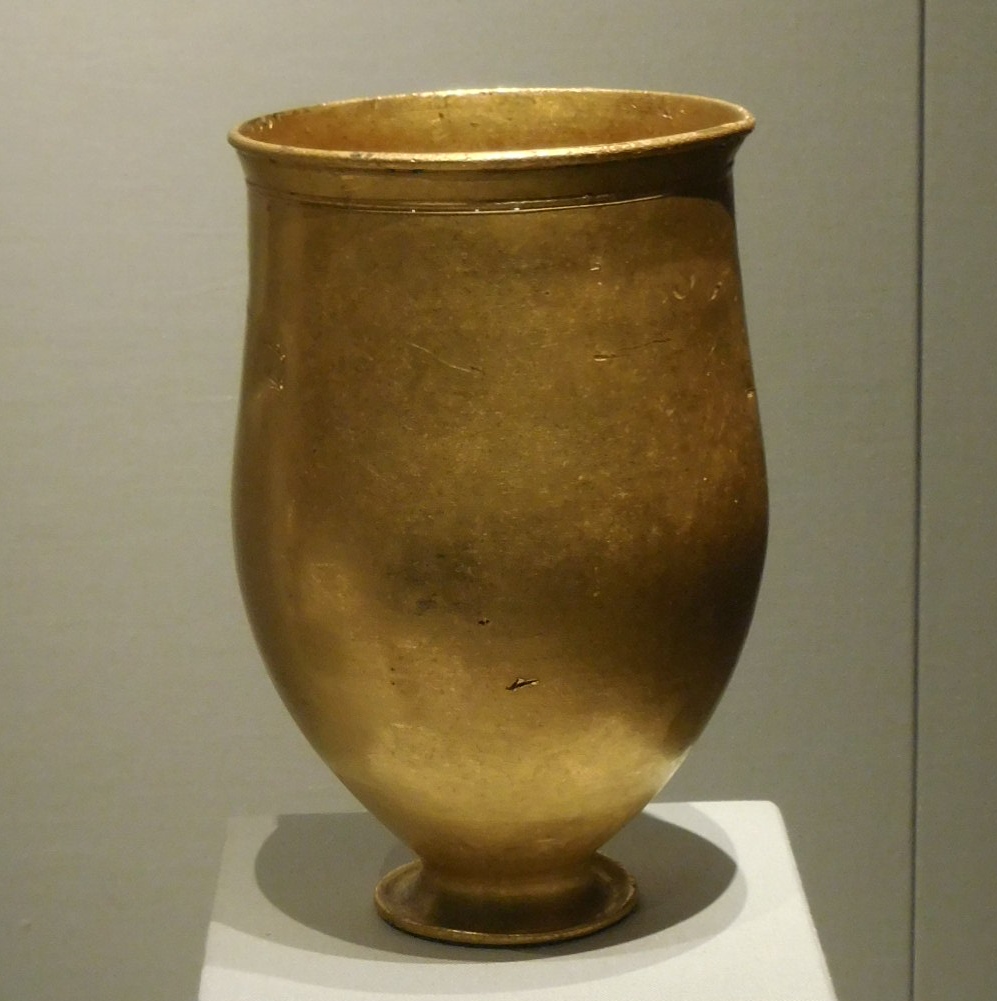
    Much more modest but still helpful was the Villa's own precious metals artefacts exhibit (mostly focusing on silver items but some gold) with a fair sampling of ancient jewelry, and these I could take photos of. They provide a nice way to illustrate the first three items mentioned in Paul's list of building materials. I've included these below with identifying tags from my visit to the Villa last summer.

Roman gold cup (gold weight = 2 libras; ca. AD 1-100)
from Knidos (Turkey)
Photo by Max Lee © 2015 Getty Villa
Greek silver wine cups (ca. 100-50 BC)
Photo by Max Lee © 2015 Getty Villa
Parthian necklace with detached pieces of
sardonyx stones as jewelry (ca. 100BC)
Photo by Max Lee © 2015 Getty Villa
Mummy Mask of a wealthy woman in Roman Egypt (ca. AD. 100)
(more on mummy masks here). Look closely around her neck and
you can see the bottom necklace composed of precious stones
Photo by Max Lee © 2015 Getty Villa
Paul in this text appears to highlight two points of comparision between the first group of gold, silver, and precious stones versus the second group of inferior building materials such as wood, grass, and stubble. He charges the church in its ministerial practices, what kind of building or body of believers are they constructing? 
    If fire here stands for divine judgment, or a metonymy for the eschatological judgment of God at our Lord's return, God tests our ministry both for 1) the quality or kind (ὁποῖόν) of work we do, and 2) whether the work remains or lasts (μενεῖ). The museum exhibits are a nice reminder that articles of gold, silver, and precious stones stand the test of time and endured to be discovered later. While there are unusual exceptions where articles of wood have been preserved (e.g., the 2000-year old fishing boat found on the bottom of the Sea of Galilee during a drought), for the most part, things built of wood, grass/hay, and stubble do not stand the test of time. They do not remain (μενεῖ) or last. 
    Pastorally, Paul's injunctions in 1 Cor 3 remind me never to present the gospel cheaply. If a preacher waters down the gospel and reduces Jesus' demand for complete surrender to something less, and this is what a person commits him- or herself to, then how watered down can the gospel be before it is no longer salvation to the one who receives it? Will such a person's salvation stand the test of present trials and persecution, let alone God's own judgment at the end of time? 
    Or, on another note, will the church I pastor stand strong until the Lord's return? What kind of disciples am I raising so that they can take the baton of faith and pass it on to a new and vibrant generation of Christian followers rising amongst our ranks? 
    The exhortations by Paul are sobering both theologically and pastorally. And the vividness of what lasts became even more colorfully illustrated by the artefacts at Getty.

Saturday, September 12, 2015

Walking through a Roman Villa at Getty

During a research trip to the libraries of UCLA and my alma mater Fuller Theological Seminary this past August 2015, I finally got my chance to visit the antiquities exhibit of Greek and Roman artefacts at the Getty Villa (not to be confused with the Getty Center in Los Angeles, which houses its medieval through modern works of art). The Villa is a stunningly beautiful campus on the hills of Malibu with a seaside view of the Pacific Ocean in California. Its artefacts are housed in a museum that is designed and (re)constructed after the architectural design of the Roman Village of Papyri (Villa dei Papiri) once owned by Lucius Calpurnius Piso, Julius Caesar's father-in-law, and home for one of 1800+ carbonized papyri scrolls at Herculaneum. So you can see why, beyond going to Italy directly, I would want to see not only their exhibits but walk through a reconstructed Roman villa itself! Here is my virtual tour of the villa replete with photos.
Welcome to the Getty Villa!
Photo by Max Lee © 2015
   As you enter into the Villa off the Pacific Coast Hwy (#1), you drive uphill into the museum entrance and present your tickets (by the way, you have to plan ahead and reserve a free ticket online before you come to the museum), pay for parking, and then walk up to the museum on a stone road that has the texture and feel of roads from Pompei.
   As you walk up the steps, the first sight you see is a reconstructed Greek theater:
Reconstructed Greek theater at the Getty Villa
(compare it to an actual Greek theater at Epidaurus)
Epidaurus is way more impressive but this was a nice first impression
Photo by Max Lee © 2015
Then you head through the entrance of the villa itself:
Entrance into the Roman domus (house)
Photo by Max Lee © 2015
You are then in the atrium area, with the impluvium (sunken part of the atrium which holds rain water) at the center, and each of the surrounding rooms along the walls is its own exhibit.
Atrium with the impluvium at the center and around the walls
are the doors to the rooms with exhibits (Greek and Roman artefacts)
Photo by Max Lee © 2015
The designers even included the compluvium on the roof (how the rain water comes in) in the atrium design.
Compluvium (hole to allow rain water through the roof)
of the Roman domus at Getty
Photo by Max Lee © 2015
Once you leave the atrium area, you then enter into the peristylium (roofed area with surrounding colonates) of the Roman house (domus) where additional rooms have more exhibits, and in the center are the basin and fountain. 
First peristylium with long basin (pond) and accompanying
Roman statues (imitations) before you enter the larger outdoor graden
Photo by Max Lee © 2015
But the above is the smaller garden area. Outside is an even larger peristylium and outdoor garden which tries to be as authentic as possible with the kinds/types of plants that are grown in ancient times, including herbs, grapes, and pomegranates.
View of the Peristyllium+Garden from the 2nd floor view of the Getty Villa
 (modeled after the Village of Papyri in Herculaneum, Italy)
Photo by Max Lee © 2015
When you walk along the walls, they painted imitations of the kind of frescos you would see if you actually visited Herculaneum. They also have some of the actual frescos but understandably not in the garden areas but in the (protected) exhibits at the Getty.
Fresco of a Peacock from Herculaneum (AD 70) on Exhibit at Getty
Photo by Max Lee © 2015
   In the weeks ahead, I will be posting more photos of the actual artefacts themselves that I took when I visited the museum's exhibits. The Getty villa actually has quite an impressive display of artefacts from the classical, Hellenistic and Roman periods. The most amazing exhibit was the mummy masks from Roman Egypt. I posted this photo of one of them on a past tweet but here it is again (below). 
Portrait of a Roman Egyptian woman Isidora,
a wealthy matriarch wearing fine jewelry from El-Hibeh,
Egypt (AD 100-10), painted on the mummy wrappings
Photo by Max Lee © 2015
All I can say, if you get to the southern California area, treat yourself to Getty Villa. It was an amazing day. Having now walked through a reconstructed Roman villa (imitation) of incredible architectual beauty, I am even more eager to some day visit Herculaneum itself and see the actual Roman Villa of Papyri along with other archaeological sites.