Showing posts with label mummy mask. Show all posts

Sunday, February 14, 2016

Paul's Use of Precious Metals to Describe Pastoral Ministry in 1 Cor 3:11-15

It just so happens that the antiquities exhibit at the Getty Villa affords an opportunity to give a photo-by-photo commentary on Apostle Paul's use of precious materials to describe the building blocks of pastoral ministry. The text I'm thinking about is 1 Corinthians 3:11-15 (my own translation below): 

11 For no one can lay a foundation beyond what has been laid, which is Christ Jesus. 12 And if anyone on this foundation builds with gold (χρυσόν), silver (ἄργυρον), precious stones (λίθους τιμίους), wood (ξύλα), grass (χόρτον), stubble (καλάμην), 13 the work of each person will become apparent, for the day will make it clear, since it will be revealed by fire and fire will test (τὸ πῦρ δοκιμάσει) one's work, the quality of each (ἑκάστου τὸ ἔργον ὁποῖόν). 14 If the work which someone built remains (μενεῖ), the person will receive a reward. 15 If one’s work is burnt up, the person will experience loss (or "will be punished," depending on how you translate ζημιωθήσεται), but he himself will be saved, but in the same way as [one gets] through fire.  (1 Cor 3:11-15)

The Getty Villa had a special Roman silver exhibit they procured from France (the Berthouville Treasure discovered in 1830) back in summer 2015, but unfortunately, the museum was very strict about not allowing any photos. I was tempted to sneak a few pic's but chickened out. 
    Much more modest but still helpful was the Villa's own precious metals artefacts exhibit (mostly focusing on silver items but some gold) with a fair sampling of ancient jewelry, and these I could take photos of. They provide a nice way to illustrate the first three items mentioned in Paul's list of building materials. I've included these below with identifying tags from my visit to the Villa last summer.
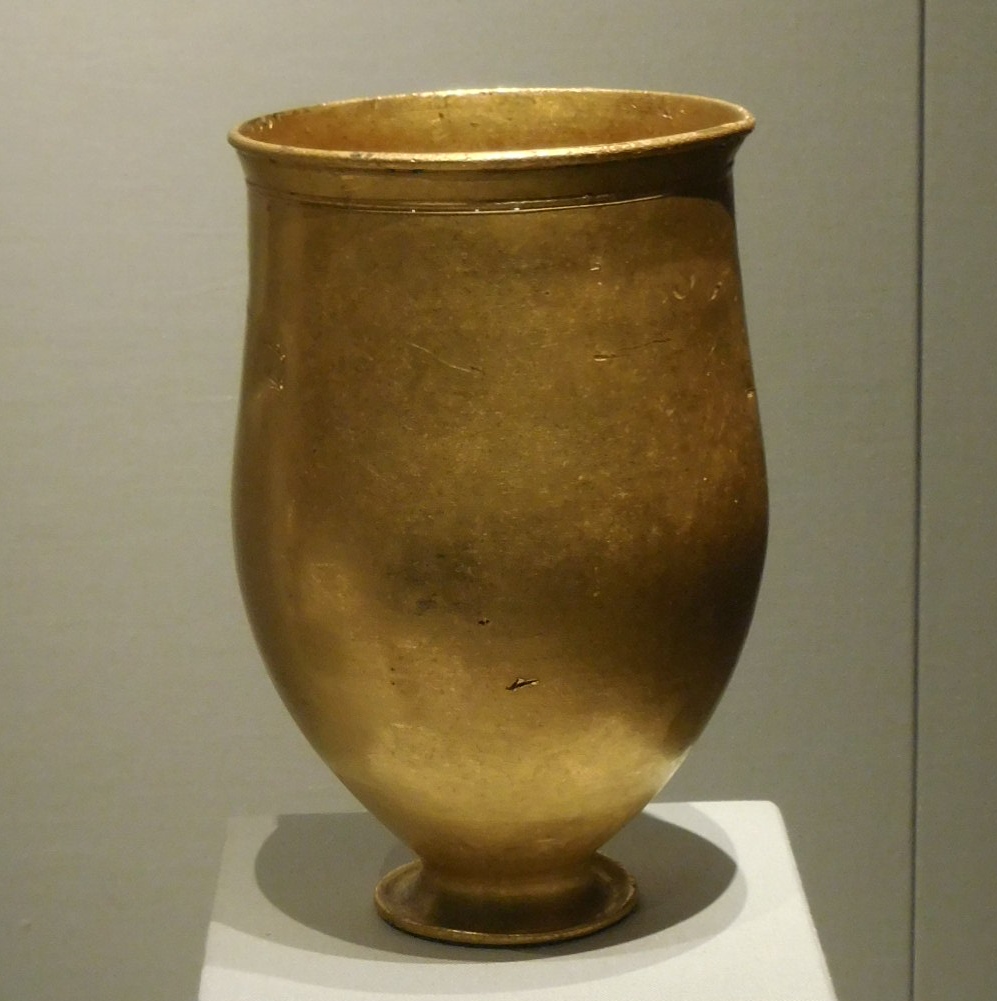
Roman gold cup (gold weight = 2 libras; ca. AD 1-100)
from Knidos (Turkey)
Photo by Max Lee © 2015 Getty Villa
Greek silver wine cups (ca. 100-50 BC)
Photo by Max Lee © 2015 Getty Villa
Parthian necklace with detached pieces of
sardonyx stones as jewelry (ca. 100BC)
Photo by Max Lee © 2015 Getty Villa
Mummy Mask of a wealthy woman in Roman Egypt (ca. AD. 100)
(more on mummy masks here). Look closely around her neck and
you can see the bottom necklace composed of precious stones
Photo by Max Lee © 2015 Getty Villa
Paul in this text appears to highlight two points of comparision between the first group of gold, silver, and precious stones versus the second group of inferior building materials such as wood, grass, and stubble. He charges the church in its ministerial practices, what kind of building or body of believers are they constructing? 
    If fire here stands for divine judgment, or a metonymy for the eschatological judgment of God at our Lord's return, God tests our ministry both for 1) the quality or kind (ὁποῖόν) of work we do, and 2) whether the work remains or lasts (μενεῖ). The museum exhibits are a nice reminder that articles of gold, silver, and precious stones stand the test of time and endured to be discovered later. While there are unusual exceptions where articles of wood have been preserved (e.g., the 2000-year old fishing boat found on the bottom of the Sea of Galilee during a drought), for the most part, things built of wood, grass/hay, and stubble do not stand the test of time. They do not remain (μενεῖ) or last. 
    Pastorally, Paul's injunctions in 1 Cor 3 remind me never to present the gospel cheaply. If a preacher waters down the gospel and reduces Jesus' demand for complete surrender to something less, and this is what a person commits him- or herself to, then how watered down can the gospel be before it is no longer salvation to the one who receives it? Will such a person's salvation stand the test of present trials and persecution, let alone God's own judgment at the end of time? 
    Or, on another note, will the church I pastor stand strong until the Lord's return? What kind of disciples am I raising so that they can take the baton of faith and pass it on to a new and vibrant generation of Christian followers rising amongst our ranks? 
    The exhortations by Paul are sobering both theologically and pastorally. And the vividness of what lasts became even more colorfully illustrated by the artefacts at Getty.

Sunday, October 18, 2015

Recovering Papyri Fragments from the Wrappings of Mummy Masks

Cartonnage bath to separate out the used papyri from a mummy mask
Photo taken from Emily Teeter's Ancient Egypt (2003)
Prior to my post on the Symposium on the Theological Interpretation of Scripture, I wrote on the mummy masks that were on display at the Getta Villa (see this post). It just so happens that last year, mummy masks were all the rave because of the possibility that some Gospel of Mark fragments dated to the late 1st century A.D. were recovered from the cartonnage (an ancient version of paper mâché made of linnen or papyri strips with glue) of a mummy mask. The claim has stirred up quite a bit of controversy and intense discussion on the blogosphere because the said Mark fragments have yet to be published (the projected 2015 date will probably be missed). Here is a random sampling of scholars who all argue for a healthy dose of scepticism until evidence/data that can be examined by the academic community becomes available: Roberta Mazza, Peter Willliams, James Tabor, to name a few.
    The claims for authenticity, however, should not be ignored because we do have two credible New Testament scholars, highly respected, who insist that the fragments are genuine and it is only a matter of time before they will be published (Brill will publish the fragments as part of the Green Scholars Initiative: Papyri Series; Michael Holmes, Director of the Green Initiative, has released this (un)official statement on his blog). Both Professor of Craig Evans, formerly the Payzant Distinguished Professor of New Testament at Acadia Divinity College, who this past June 2015 recently accepted a new post at Houston Baptist University, and Professor Daniel Wallace of Dallas Theological Seminary and known textual-criticism expert, are eager to answer critics once the papyri have been published. Apparently a non-disclosure statement with the owners of the mummy mask from which the papyri were extracted keeps Evans and Wallace from saying any more. The hornet's nest was stirred when Evans, back in 2014, made this announcement during a lecture (see below): 
Almost immediately, the news media picked up on the announcement and posted articles from it and from an earlier press leak by Daniel Wallace during a debate with Bart Ehrman in 2012 (see Forbes, Live Science, The Smithsonian, The Washington Post, and the Christian Today). 
   I personally will simply wait until the Brill publication becomes available before making my own deliberation on the authenticity of the fragments. There is really nothing more anyone can do until they are published. But pedagogically, the whole process is a great segue to sharing with seminary students how some of our manuscripts and papyri fragments have fascinating stories of their own about their discovery. Aside from the incidental coincidence that mummy masks fit the October halloween theme, the anticipation concerning the Gospel of Mark fragments is a good way to talk about how papyri discoveries come from the oddest places: the garbage dumps of Egypt (think Oxyrhychus), on palimpsest (another form of recycled papyri), Christian monasteries (think Bodmer), or on the antiquities black market. 
    In the case of the mummy mask, with all the secrecy, I suspect that a private collector is involved (but this is only speculation). While we wait for Brill to publish the Green Scholars Initiative papyri series, below is a helpful video which outlines the process that some archaeologists / papyrologists used to protect the painted portrait of the mummy mask while still being able to extract the cartonnage and separate its layers to read the recycled papyri. Have fun! 
Video of Jaakko Frösén (University of Helsinki)
demonstrating how to extract the papyri from a mummy mask
without damaging the painted portrait

One more photo: Life Science has a nice article how renowned classicist Dirk Obbink discovered two poems of Sappho from the mummy cartonnage of a private collector. You can read the article (here). Below is the photo of the recovered papyrus scroll fragment from the cartonnage. Wow! It's amazing that it could be restored with such clarity.
Photo credit: livescience.com
Postscript 10/19/15: One of Roberta Mazza's students found this video on the mummy mask from which the Gospel of Mark fragments came (or at least, this was the mummy mask used on the powerpoint screen for the announcement). If this is indeed the mummy mask, and I'm no expert, it sure makes even me nervous how the mask and papyri was handled. Watching the video can be nerve-wracking as you see the masked and papyri handled by several people. I hope the Green Scholars Initiative is taking care of the papyri well, and the faster Brill publishes it, the better. MJL

Saturday, September 19, 2015

Mummy Masks and Roman Egyptians

One of the best exhibits at the Getty Villa was the display of mummy masks from Roman Egypt. The use of portaits painted on the head of a mummy is a combination of Egyptian burial customs and Roman individualized portraiture traditions. Often wood panels are used for the portrait and later inserted into the mummy's linen wrappings. Pigments were suspended in bee's wax and brushes used to paint the face of the dead onto the panel. Sometimes a hardening agent like eggs yolk was applied. 
   Besides the excellent example of the mummy mask shown in my previous post, here are some of the other mummy portraits on display at the Villa (forgive some glares; I did my best to try to get a clean photo through the protective glass of the display):
Portrait of a Roman-Egyptian Man (AD 200-25)
Cropped hairstyle reflects the Severan era
Photo by Max Lee © 2015
Portrait of an Roman-Egyptian Woman  (AD 170-200)
Dress, jewelry, and hairstyle depict a matriarch of wealth
Photo by Max Lee © 2015
Portrait of a Roman Egyptian Man (AD 200-50)
holding a glass of wine and garland of flowers which
are typically associated with funeral rites
Photo by Max Lee © 2015
Rarely does one find a perfectly preserved mummy in antiquity, but the Getta Villa has one on display which shows nicely how the wood panel portraits like above were inserted in the wrappings of the mummy. Below is the mummy of the Roman Egyptian Herakleides (AD 50-100): 
Mummy Body of the Roman Egyptian Herakleides (AD 50-100)
Photo by Max Lee © 2015
Photo shows how the mummy portrait panel was inserted in the wrappings
and the body itself was decorated further with symbols of protection and rebirth
Photo by Max Lee © 2015
We are not exactly sure why the Egyptians created headmasks (often gold) which later evolved into the Roman practice of life-like portraits on wood panels inserted on top of the head coverings. But it may be that the spirit of the person was believed to be wandering around during the day and in order to return to its body at night, the portrait was there to help the human spirit recognize its own body.
     Also worth noting is how the name of the man was written in Greek just above the feet. It's hard to see but you can make out ΗΡΑΚΛΕ[ΙΔΗΣ] if you stare at the photo below:
The feet of the mummy body with the letters ΗΡΑΚΛΕ- - - - written in Greek
just above to the left. The missing letters are visible upon closer inspection
though hard to see in the above photo
Photo by Max Lee © 2015
I find the exhibit utterly fascinating for the example of cultural assimilation that has taken place among Egyptian religious practices. The portraits are ethnic Egyptians but these Egyptians are dressed like Romans! The names are spelled out in Greek. The ancient Mediterranean world was far more cosmopolitan than we might initially suspect, and the influence of Rome affected even the burial rites of the colonized population.
   But there is another reason why I wanted to see this exhibit. Sometimes, instead of linen, strips of papyri were used with glue to make the cartonnage, or the cardboard-like materials created from plastering the mummy wrappings, much like children who make crafts from paper-mâché. Sometimes, the papyri they use are recycled from written texts and scrolls. The trick, then, is how to peel away the layers of paper-mâché papyri from the mummy mask or body and recover the written texts they contain. For New Testament scholars, much ado has been made about the possibility of a Gospel of Mark fragment discovered in a mummy mask (yet to be verified by the way!). More on this in the next post. For now, enjoy the photos from an incredible exhibit at Getty.