Showing posts with label corinth. Show all posts

Monday, May 28, 2018

Intertextuality in the New Testament Section SBL Denver 2018

Invited Plenary Speakers for the Intertextuality in the New Testament Section
Theme: Ancient Exegetical Methods in
Greco-Roman Discourse and the New Testament
SBL Denver 2018
It's been quite some time since I revisited my blog but I have not forgotten about it. But I did need the timely break to get a sense on how to manage my time as the chair of the biblical field at North Park Theological Seminary.
    In this post, I'm excited to announce the opening plenary session of the Intertextuality in the New Testament Section at the Society of Biblical Literature Annual Meeting in Denver this November 2018. The theme of the session is Ancient Exegetical Methods in Greco-Roman Discourse and the New Testament. Much ink has been spilt on how the New Testament authors quote, cite, echo, and allude to Old Testament and Jewish texts in their writings, but little has been done on the way they quote, echo, allude or recontextualize Greco-Roman sources. The three main presenters who are giving papers on various intertexts between Greco-Roman discourse and the New Testament are all experts in their respective fields and have masterfully engaged with a wide range of rhetorical, religious, political and philosophical material by Greek and Roman authors. The speakers and their papers titles are listed below. 
     I especially want to highlight that the respondent to each of the papers is Peter Oakes. Anyone having read his 2005 journal article in JSNT entitled "Remapping the Universe," where he outlined four possible ways the New Testament texts allude, echo, appropriate or compete with Roman imperial texts/theology would know that there are few who could comment on not only the specific content of the papers but on the broader issue of how to map out a method for detecting Greco-Roman textual and conceptual allusions in the New Testament. It's sure to be a fantastic session. I hope all attending SBL and reading this post will come to the session on Saturday morning Nov 17, 2018. Best! MJL


Intertextuality in the New Testament
11/17/2018
9:00 AM to 11:30 AM
Room: Room TBD - Hotel TBD

Theme: Ancient Exegetical Methods in Greco-Roman Discourse and the New Testament
Each paper will be 25-30min long. Peter Oakes will be responding after each paper for 10min. There is a general discussion at the end of the session

Max Lee, North Park Theological Seminary, Presiding

Bruce Longenecker, Baylor University
Intertextuality in Pompeian Plaster: Can Vesuvian Artifacts Inform Our Expectations about Intertextual Expertise among Sub-Elite Jesus-Followers? (30 min)

Peter Oakes, University of Manchester, Respondent (10 min)

Judith M. Gundry, Yale Divinity School
Roman Household Religion and the Interpretation of 1 Corinthians 7:14 (30 min)

Peter Oakes, University of Manchester, Respondent (10 min)

Paul Trebilco, University of Otago
Echoes in Ephesus: ‘From the beginning’ in the Johannine Letters and in Ephesian Foundation Myths (30 min)

Peter Oakes, University of Manchester, Respondent (10 min)

Discussion (30 min)

Business Meeting (0 min)

Sunday, February 14, 2016

Paul's Use of Precious Metals to Describe Pastoral Ministry in 1 Cor 3:11-15

It just so happens that the antiquities exhibit at the Getty Villa affords an opportunity to give a photo-by-photo commentary on Apostle Paul's use of precious materials to describe the building blocks of pastoral ministry. The text I'm thinking about is 1 Corinthians 3:11-15 (my own translation below): 

11 For no one can lay a foundation beyond what has been laid, which is Christ Jesus. 12 And if anyone on this foundation builds with gold (χρυσόν), silver (ἄργυρον), precious stones (λίθους τιμίους), wood (ξύλα), grass (χόρτον), stubble (καλάμην), 13 the work of each person will become apparent, for the day will make it clear, since it will be revealed by fire and fire will test (τὸ πῦρ δοκιμάσει) one's work, the quality of each (ἑκάστου τὸ ἔργον ὁποῖόν). 14 If the work which someone built remains (μενεῖ), the person will receive a reward. 15 If one’s work is burnt up, the person will experience loss (or "will be punished," depending on how you translate ζημιωθήσεται), but he himself will be saved, but in the same way as [one gets] through fire.  (1 Cor 3:11-15)

The Getty Villa had a special Roman silver exhibit they procured from France (the Berthouville Treasure discovered in 1830) back in summer 2015, but unfortunately, the museum was very strict about not allowing any photos. I was tempted to sneak a few pic's but chickened out. 
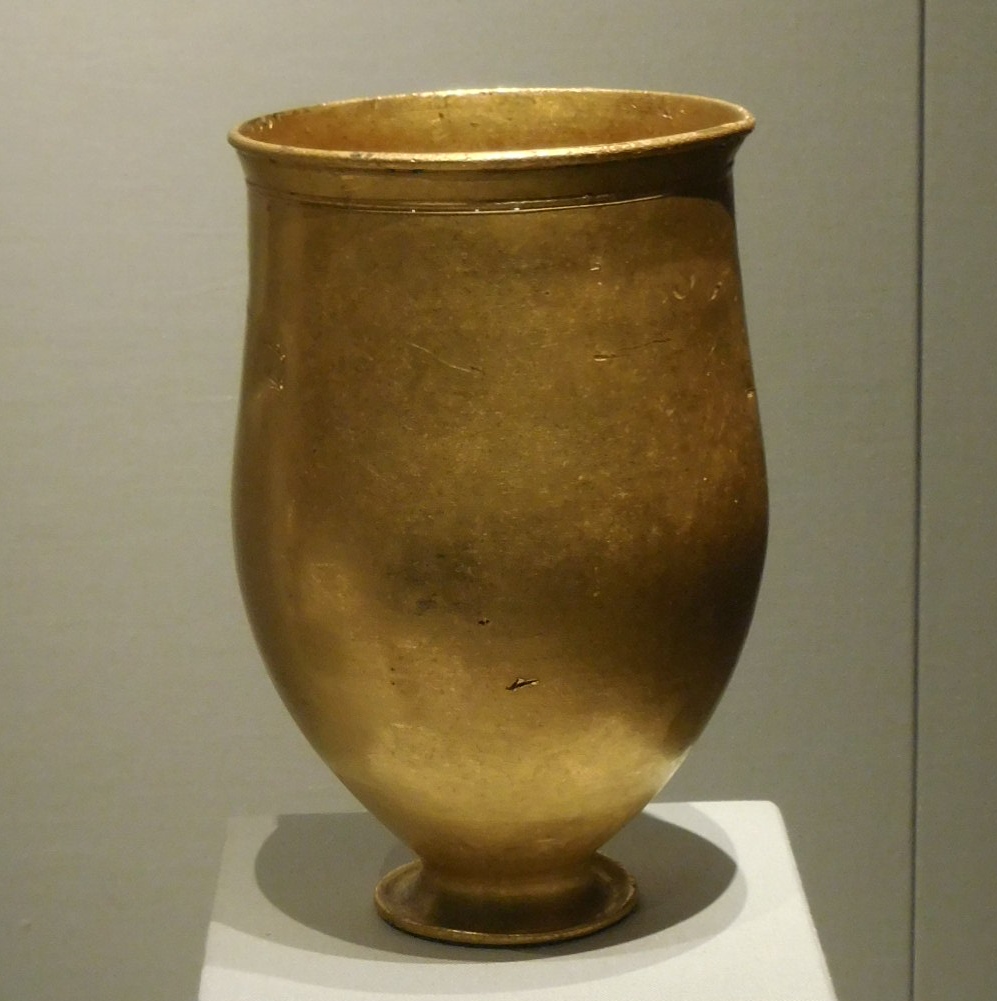
    Much more modest but still helpful was the Villa's own precious metals artefacts exhibit (mostly focusing on silver items but some gold) with a fair sampling of ancient jewelry, and these I could take photos of. They provide a nice way to illustrate the first three items mentioned in Paul's list of building materials. I've included these below with identifying tags from my visit to the Villa last summer.

Roman gold cup (gold weight = 2 libras; ca. AD 1-100)
from Knidos (Turkey)
Photo by Max Lee © 2015 Getty Villa
Greek silver wine cups (ca. 100-50 BC)
Photo by Max Lee © 2015 Getty Villa
Parthian necklace with detached pieces of
sardonyx stones as jewelry (ca. 100BC)
Photo by Max Lee © 2015 Getty Villa
Mummy Mask of a wealthy woman in Roman Egypt (ca. AD. 100)
(more on mummy masks here). Look closely around her neck and
you can see the bottom necklace composed of precious stones
Photo by Max Lee © 2015 Getty Villa
Paul in this text appears to highlight two points of comparision between the first group of gold, silver, and precious stones versus the second group of inferior building materials such as wood, grass, and stubble. He charges the church in its ministerial practices, what kind of building or body of believers are they constructing? 
    If fire here stands for divine judgment, or a metonymy for the eschatological judgment of God at our Lord's return, God tests our ministry both for 1) the quality or kind (ὁποῖόν) of work we do, and 2) whether the work remains or lasts (μενεῖ). The museum exhibits are a nice reminder that articles of gold, silver, and precious stones stand the test of time and endured to be discovered later. While there are unusual exceptions where articles of wood have been preserved (e.g., the 2000-year old fishing boat found on the bottom of the Sea of Galilee during a drought), for the most part, things built of wood, grass/hay, and stubble do not stand the test of time. They do not remain (μενεῖ) or last. 
    Pastorally, Paul's injunctions in 1 Cor 3 remind me never to present the gospel cheaply. If a preacher waters down the gospel and reduces Jesus' demand for complete surrender to something less, and this is what a person commits him- or herself to, then how watered down can the gospel be before it is no longer salvation to the one who receives it? Will such a person's salvation stand the test of present trials and persecution, let alone God's own judgment at the end of time? 
    Or, on another note, will the church I pastor stand strong until the Lord's return? What kind of disciples am I raising so that they can take the baton of faith and pass it on to a new and vibrant generation of Christian followers rising amongst our ranks? 
    The exhortations by Paul are sobering both theologically and pastorally. And the vividness of what lasts became even more colorfully illustrated by the artefacts at Getty.

Monday, February 8, 2016

Once Again the Brutality of Ancient Boxing: Lessons from the Getty Villa Museum

It's back to business and the main focus of this blog: interpreting the Apostle Paul in his Greco-Roman context. In the past, I had done a series of posts on athleticism in the Mediterranean world during the early imperial period of Rome. But when I was visiting the Getty Villa last summer, I came across a stunning mosaic from the Gallo-Roman period discovered in the archaeological ruins of a Roman villa in present-day Villelaure, France. I thought it worth discussing the boxing scene depicted in this mosaic floor made of stone and glass:
Roman Mosaic of two Boxers (ca. A.D. 175)
Photo by Max Lee © 2015 from the Getty Villa
In the above photo, we have the artist's depiction of the aged Sicilian boxing champ Entellus (left) and the younger Trojan hero Dares (right) who is bleeding from a wound inflicted by Entellus. In the background is the prize bull for the winner (no-brainer: Entellus won!) which, according to Virgil's Aeneid, was punched so hard by Entellus, he cracked the bull's skull and killed it as a sacrifice to the gods. 
    Even more interesting is how both boxers wear caesti or leather gloves, often wrapped with iron balls or lead around the boxers' hands to increase the force of the blows. It goes without saying that such blows could prove fatal in the ring.
    The mosaic is a shocking reminder that boxing was brutal in the ancient world, and the athlete who engages in it required focus, stamina, discipline, training and endurance. Ancient boxers made modern MMA fighters look like wimps. 
    Therefore it is all the more striking (pardon the pun!) how the Apostle Paul uses the boxing metaphor to describe the discipline and focus needed in ministry: 

25 Every competitor/athlete (ὁ ἀγωνιζόμενος) exercises self-control over all things; they do this to receive a perishable wreath, but we an imperishable one. 26 So I do not run aimlessly, nor do I box (πυκτεύω) as though beating the air; 27 but I punish my body and enslave it, so that after I proclaim (κηρύξας) [the gospel] to others, I myself shall not become disqualified. (1 Cor 9:25-27)

The minister is the spiritual athlete. The one who proclaims the gospel to others and learns to become all things to all people so that by all means he or she might save some (cf. 9:22) requires the focus and precision of an expert boxer who disciplines one's own body and trains it, but also stays on mission without distraction. Everyone who preaches the gospel knows that ministry can be more brutal than boxing.

Monday, September 1, 2014

The Irritating Bite vs. the Sting Which Kills

It's been hard to blog with the start-of-the-semester madness, but finally, I can get back to my previous post on Philodemus' treatise On Death (Book IV). 
   There I wrote about how the Epicurean sage manages grief and fear by cutting out from a person's natural aversion to death whatever wrong ideas or superstitions he or she has attached to it. Philodemus is especially critical of associating with death the idea of divine judgment according to the myths of his day (κατὰ τοὺς μύθους); he would not be very receptive to the idea of that we are all assigned a place in Hades (πρὸς τὸν ἀποδεδειγμένον αὐτοῖς καθ' Ἅιδου χῶρον) in the afterlife where furies torture the wicked (IV.27.8-14; Henry ed.). Thus, Epicurean philosophical therapy is the process of rationally dispelling such myths concerning death, with the result that the great pain (μεγάλην... λύπην; 25.11-12) fueled by false ideas is reduced to a natural bite or sting (φυσικὸς ὁ δηγμός; 25.36). 
   Apparently, this remainder which is left over, the natural bite, after myths and superstitions have been cut out, is actually useful for the philosopher. For one thing, it humanizes the Epicurean since it is unnatural for a person to feel nothing when one's loved ones have passed away (you can see Philodemus taking a jab here against the Stoics who argued that the sage is "apathetic" to grief). A natural aversion to death (= death's bite) can also encourage a person to live well and wisely in the present (37.12-38.25; see Armstrong, 45-49*), much in the same way natural anger without false ideas about vengeance helps a person to seek justice for wrongs done (cf. Philodemus, On Anger, col. 67). 
Silver Tetradrachm (Greek: τετράδραχμον) coin from Ephesus
featuring a bee and stag (ca. 390-130 BC)
image credit: coinquest.com
So the key to Epicurean therapy is reducing great pain to a manageable, useful, and natural bite. Death is nothing but an irritating sting or bite that should not be feared. 
    But Paul's understanding of personified Death (θάνατε) and its sting (τὸ κέντρον) is that the latter is no small bite or peck like that of a mosquito. Rather, like some ancient species of wasps, bees, and scorpions of Paul's day, a sting can kill you (1 Cor 15:54-55; cf. Aristophanes, Wasps 403-407). There is a double entendre here. Paul's use of κέντρον refers to both the torturing device of personified Death (click here for details) and also the (insect's) sting which kills and ends life. In contrast to the Epicureans, Paul does not think the reality of divine judgment and justice is a false myth but part of the eschatological reality which frames the gospel of Jesus Christ. There is a divine law to which all must answer. While Paul's vision of the afterlife is nothing like Virgil's description of Hades (Aeneid, Book 6), he nevertheless does not discount the idea that God does exact justice for all humanity at the resurrection of the dead. Nor does Paul think any rationalization process could ever remove the agony which death brings. 
   Instead, the only solution is to remove the sting altogether. Death has no power over Christian believers because God will raise them up on the day of Jesus' return. Why settle for a bite, when God, through Christ, has conquered death's crippling effect on human life once and for all?! 

* See David Armstrong, "All Things to All Men: Philodemus' Model of Therapy and the Audience of De Morte," in Philodemus and the New Testament World (NovTSup 111; Leiden: Brill, 2004), 15-54. 

Monday, August 18, 2014

The Sting of Death according to Paul

In a previous post on common popular fears surrounding the afterlife (here), I commented on Virgil's depiction of Hades in the Aeneid and showed pictorially one anonymous artist's rendition of the three judges of Hades (Rhadamanthus, Midos, and Aeacus) preserved on an Apulian red-figure volute κρατήρ (= a wine diluter; ca. 330-32o BC). There we read a graphic description from Virgil, and we saw a graphic picture from the "Underworld Painter," of how the warden of hell, Rhadamanthus, ordered a fury to whip and torture those souls guilty of heinous crimes in their earthly life. This image of divine judgment and justice in the afterlife is an important point of cultural and religious engagement for understanding Paul's triumphant discourse in 1 Cor 15:55-57: 
  • Where, O Death (θάνατε), is your victory (τὸ νῖκος)? Where, O Death, is your sting (κέντρον)? 56 The sting of death (τὸ κέντρον τοῦ θανάτου) is sin (ἁμαρτία), and the power of sin (ἡ δύναμις τῆς ἁμαρτίας ) is the law (ὁ νόμος). But thanks be to God who gives to us victory through Jesus Christ our Lord!
This is a very packed set of verses. What does Paul mean by the sting of death? The Greek word for "sting" is κέντρον and can mean something like a venomous sting of a bee, wasp, or scorpion. But it can also refer to a sharp object or goad used to spur horses, oxen, or other beasts of burden. A photo of a κέντρον held in the hand of the charioteer is shown below and circled in yellow
Chariot Racing from a 510 BC Attic Hydria
The κέντρον or horse's goad (circled in yellow)
image credit: wikipedia commons
The κέντρον, as early as Herodotus (Histories 3.130), was also used to torture prisoners of war and criminals. It was a torturing device used punish the wicked (cf. Aristophanes, Wasps 403-407).
    In the mythic world of the Aeneid, it was the furies who held whips, goads, and other weapons to torture and punish wrong-doers. But in 1 Cor 15:55, Death itself holds the κέντρον. The vocative θάνατε personifies Death, and Paul taunts Death as the last enemy. Or, as Garland puts it, "does Paul picture death wielding a goad in its hand to rule over humans and torture them?" (Garland, 1Cor, p. 745). Is Death a military general, believing it has victory (τὸ νῖκος) at hand (because of Adam's fall), but only to find its victory stripped away, disarmed of its ability to torture and goad humanity any more, because of Christ's death and resurrection? Here is my interpretative translation of 1 Cor 15:55-57 once more:
  • Where, O Death, you last of the apocalyptic superpowers, is your victory? You were robbed of your victory by Christ's death and resurrection. Where, O Death, is your ability to torture and punish humanity? Where is your sting? 56 It used to be that Sin could torture, goad, and punish humanity as Death's ally. Sin is the sting which culminates in death. The Law gave sin its power and authority to accuse humanity for failing to observe the commandments. 57 But not any more! Thanks be to God who through the cross and resurrection of Christ removes the sting from death by providing forgiveness for sin and vindicates believers at the resurrection by overcoming their death with new life. 
Christ's resurrection is Paul's historical anchor and theological point of assurance that the triple threat of Death, Sin, and the Law (when it empowers sin to accuse) has been neutralized forever. Christ snatches victory from Death and hands victory instead to God's people. Where is your (σου) victory, O Death? I'll tell you where it went, says Paul. God gave it to us (ἡμῖν) through Jesus Christ our Lord. Wow! Can I get an "Amen!" from the congregation out there?!
   In my next post, I will compare the Philodemus text on the "sting" and "bite" of death with Paul's reference to death's goad here in 1 Cor 15. While it is possible that the lexemes τὸ νύττεσθαι and δηγμὸν used by Philodemus are synonymous with the way Paul employs the word κέντρον, there are also very clear differences. But for now, we can simply all be challenged by Paul's taunt against stingless Death and his unwavering confidence in what God had done through Christ. 

Monday, June 2, 2014

Before MMA, There Was the Pankration

Lately, I've been trying to get myself back to the gym and into shape. So athletic training has been on my mind. Today, I thought I would write a blurb about the pankration (Greek παγκράτιον; Latin pancratium). This was one of the most vicious competitions in the Greek athletic games which combined both boxing and wrestling. In many ways, it was an ancient form of modern-day mixed martial arts. Aristotle describes the athletic events this way: 
  • Bodily excellence in athletics (ἀγωνιστική) consists in size, strength, and swiftness of foot; for to be swift is to be strong. For one who is able to throw his legs about in a certain way, to move them rapidly and with long strides, makes a good runner (δρομικός); one who can hug and grapple, a good wrestler (παλαιστικός); one who can thrust away by a blow of the fist, a good boxer (πυκτικός); one who excels in boxing and wrestling is fit for the pancratium (παγκρατιαστικός)... (Aristotle, Rhetoric 1361b.14; LCL; Eng. trans. by Freese)
Painting of Theseus' Battle with the Minotaur in the Labyrinth
from an Attic kalyx crater (wine-diluter) ca. 480 BC
Photo taken by Max Lee © 2014 Athens Museum
Legend has it that the pancration was a technique created by Theseus as he fought against Minotaur in the labyrinth. According to Dio Cassius, Emperor Caligula popularized the sport in Rome (Roman Histories 59.13). It was very likely still a crowd favorite at the Isthmian games sponsored by Corinth at the time when Paul visited the city. The winner was determined when the loser was killed or "tapped out" by slapping the side of the victor in a gesture of submission. 
   The pancration gives us just one more example of how radical Paul's use of the athletic metaphor was to describe the kind of discipline, training, and endurance which the Christian athlete needed to exercise self-control over wrong desire. 
Picture of two pankratiasts fighting (center), a trainer (right) and onlooker (left)
from an Attic skyphos (wine-cup) ca. 500 BC
Image Credit: Wikimedia Commons

Saturday, May 24, 2014

Ministry Can Be More Brutal than Boxing

Continuing from my last post on Lucillius' epigrams satirizing the viciousness of ancient boxing, I turn to 1 Cor 9:24-27 where Paul makes an explicit comparison of the athlete (runner, boxer) with the challenges of Christian life and ministry. 
Ancient Wrestling (grave relief; 510BC)
Photo taken by Max Lee © 2014 Athens Museum 
  This athletic illustration is actually the 2nd used by Paul as part of his ongoing exhortation that the Corinthians give up their rights (to eat idol food) and express their freedom by loving their fellow brothers and sisters in the church. In 9:1-23, Paul uses himself as an example by explaining how he gave up his apostolic rights to receive material support so that he could present the gospel "free of charge" to the Corinthians. In 9:24-27, Paul appeals to the example of competitive Greco-Roman sports to talk about the self-control (ἐγκράτεια) and discipline needed to deny one's desires. In 10:1-13, Paul turns to the wilderness generation of Israel's exodus to warn the Corinthians against the consequences of letting wrong desire and idolatry spiral out of control (Thiselton, 1Cor, 708-9). Concerning the 2nd athletic metaphor, I cite my translation of the text again and highlight two exegetical points:

Do you not know that in the stadium (σταδίῳ) all the runners run, but only one receives the prize? So run in this way that you may receive it. 25 Every competitor/athlete (ὁ ἀγωνιζόμενος) exercises self-control over all things (πάντα ἐγκρατεύεται); they do this to receive a perishable wreath (στέφανον), but we an imperishable one. 26 So I do not run aimlessly, nor do I box (πυκτεύω) as though beating the air; 27 but I beat my body (ὑπωπιάζω μου τὸ σῶμα) and enslave it (δουλαγωγῶ), so that after I proclaim (κηρύξας) [the gospel] to others, I myself shall not become disqualified.
  1. Paul remaps the violence done to one's opponent to himself, literally to his own body (μου τὸ σῶμα). Pardon the pun, but the verbs he uses to illustrate self-control are "striking": "beat" (ὑπωπιάζω), "enslave/subdue" (δουλαγωγῶ), "box" (πυκτεύω) and "struggle against" (ἀγωνίζομαι). 
  2. Paul remaps the temporary honor and glory received by the victor on behalf of his city (symbolized by the perishable wreath στέφανον), to the eternal honor and glory of the Christian (symbolized by an imperishable wreath) who receives his/her recognition from God, and it is this God and his gospel which are proclaimed (κηρύξας). 

   Concerning the 1st point: We are our own worst enemy.  Me, myself and I constantly get in the way of loving the other person. At the core, we don't want to love, we don't want to sacrifice, we don't want to give up our rights but guard them violently. People can be such blackholes of ingratitude (i.e., they receive what we give, suck it up like a blackhole, and not reciprocate anything in return, let alone any thanks). So why deny ourselves and go the extra mile to love them? But paradoxically, Paul not only insists that we do, but he considers the practice of denying our appetite and especially our ego as the greatest expression of Christian freedom. To do this, God has to suspend the grip and gravity of sin and enable the Christian athlete to struggle against his/her own selfish impulses, beat them into submission, and pursue a different course other than self-preservation: that is, sacrificial love and service. Ministry can be more brutal than boxing, because we have to constantly fight against our own resistance to serve.
   Concerning the 2nd point: for whom do we run and for what do we box? Hopefully, at the end of the day, even if the other person never responds to our relinquishing of rights for their sake, the glory will go to the Lord Jesus Christ because of how we struggled, both against ourselves and for the service of others. If I run for myself, I'll burn out. Run for Christ, and He acknowledges and sustains me.

Postscript: The above photo of a grave relief (probably of a famous athlete) was taken at the Athens museum during my Greece trip this past January 2014. In the center, two athletes are wrestling with one another. The left wrestler is ready to jump into the fray, and the right person is preparing the pit where the match takes place. Yes, they are naked, and athletes did complete this way during the classical period from which this relief comes (ca. 510 BC).

Saturday, May 17, 2014

The Brutality of Boxing in the Greco-Roman World

I'm reading through some ancient Greek and Latin epigrams from the Roman period for fun as a way to treat myself after an intense week of grading. Some of them are really humorous, since many epigrams are parodies of various cultural features of Greco-Roman life. The English translation I'm reading is by Gordon Fain in his Ancient Greek Epigrams (201o). The Greek text varies, but most is translated from Anthologia Palatina
    I wanted to share something from Lucillius, 1st century AD court poet commissioned by Emperor Nero, who has some vivid descriptions of the brutality of boxing in the ancient world in some of his satirical poems which poke fun at ancient athleticism. Here are two that deserve a closer look (with key words in Greek highlighted in blue; where I modified Fain's translation in green

Epigram 1 (= AP 11.81)
At all the contests (ἀγωνοθετοῦσιν) where Greeks appear, 
I fought (ἀγωνισάμαν) Androleos at every one
My prize at Pisa was to save one ear
At Plataia, one eyelid is what I've won.

At Delphi, I was carried out as dead
My father with citizens (ὁ πατὴρ σὺν πολιήταις)
    were proclaimed (καρύσεττο),
And told to lift me up so I'd be led
Out of the stadium (σταδίων), a corpse or maimed

Epigram 2 (= AP 11.75)

This man Olympikos whom now you see, 
Augustus [= Nero], had a nose,
Chin, forehead, ears and eyelids, then he
A boxer's (πύκτης) calling he chose

And lost them all, so his birthright, too, 
He couldn't even claim;
His brother put his portrait up to view:
The court said, "Not the same!"
(Eng. trans. by Fain, Ancient Greek Epigrams, p. 212)

Greco-Roman boxing could send you home dead or crippled for life, to say the least. No gloves, and bare-fisted, these ancient athletes make modern MMA fighters look like wimps. 
   In the first epigram, Lucillius jokes that the real prize for a boxer is walking away saving one of two ears, or an eyelid. In the 2nd, Lucillius explains to Nero that one boxer Olympikos was so maimed, he became unrecognizable. He could not claim his inheritance because his mutilated face was nothing like the portrait his brother brought to court. The court did not think the boxer vs. the heir in the painting were the same. 
   But what is particularly striking is the irony of the 1st epigram. Boxers fought not for their own honor but for the praise and glory of the city they represented. While the father and citizens of one city lifted up the winning boxer in victory and paraded him around the stadium, the winner ironically looked more like a corpse than a victor. 
   In my next post, I want to look at Paul's famous comparison of the ancient runner, boxer, and athlete with the Christian minister in 1 Cor 9:24-27. May be you can make some insights of your own as you look at what key phrases are parallel with the epigrams above: 

Do you not know that in the stadium (σταδίῳ) all the runners run, but only one receives the prize? So run in this way that you may receive it. 25 Every competitor/athlete (ὁ ἀγωνιζόμενος) exercises self-control over all things; they do this to receive a perishable wreath, but we an imperishable one. 26 So I do not run aimlessly, nor do I box (πυκτεύω) as though beating the air; 27 but I punish my body and enslave it, so that after I proclaim (κηρύξας) [the gospel] to others, I myself shall not become disqualified.

Wednesday, April 30, 2014

The Earth Is the Lord's... and a Beautiful Day in Chicago Can Be Miraculous

Just when I blogged in my previous post about giving up my rights for the sake of serving others, I was also reminded that I need not rupture the theological tension between an ethics of pleasure (based on what God considers good) and an ethics of sacrifice for the good of my neighbor. I was dropping my teenage son off at the Adler Planetarium last Saturday for his internship there as an astro-journalist, when I decided to stick around the area (instead of driving home) and simply enjoy the beauty of a nice sunny Chicago day (such a welcome relief after the brutal winter we had!). Walking along Lake Michigan, I enjoyed this scene: 
Photo taken with my iphone near the Adler Museum
When Paul quotes Psalm 24:1 (= 23:1 LXX) concerning his teaching on idol food in 1 Cor 10:26: "The earth and its fullness are the Lord's" (τοῦ κυρίου γὰρ ἡ γῆ καὶ τὸ πλήρωμα αὐτῆς), he reminds the Corinthians that: 1) if there is anything good in the world, it is comes as a gift from God since everything belongs to Him; and 2) therefore, we can celebrate the sovereignty of God, especially over false idols and fake gods, and receive with gratitude creation-gifts which are a sign of the Creator's grace and favor. It is also likely that Paul drew the quotation of Psalm 24:1 from the common practice in Judaism to recite this verse (along with others; e.g., Pss 50:12; 89:11) as part of the prayers voiced before a meal (see b. Sabb. 119a; Garland, 1Cor-BECNT, p. 482).
    Despite the rain all this mid-week, I was reminded this past weekend about how good the Lord is, and how beautiful the earth can be, as I took a much needed prayer walk around the sunny shoreline of Chicago. Blessings! 

Saturday, April 26, 2014

Epilogue on Idol Food: An Ethics of Pleasure in Theological Tension with the Freedom of the Christian

In my last series of posts, I wrote on how Paul engages with the Corinthian church and answers their questions concerning the permissibility and non-permissibility of idol food consumption (1 Cor 8-10). There I argued that Paul, based on a theology of creation, considered all food (including what was sacrificed to idols) as gifts from the Creator to be enjoyed (Psalm 24:1 [= 23:1 LXX] in 1 Cor 10:26). Therefore, idol food bought at the market and eaten at home was not to be feared. The believer was also free to eat idol food which was served in the non-cultic setting of banquet halls at the temple. But as soon as the believer entered a cultic, liturgical setting, idol food consumption was prohibited based on the real presence of demons in the very act of pagan worship.
   Having gone to such great lengths to outline a rather nuanced ethic concerning idol food consumption, Paul then flips the entire set of instructions on its heels when he insists that "if a brother or sister stumbles, may I never ever eat meat for all eternity!" (8:13). The freedom to forsake one's rights for the love of a brother and sister in Christ trumps an ethics of pleasure and any entitlement I have for food or other material goods. 
   Last Palm Sunday (4/13), when I attended the CollegeLife worship service at North Park University, I heard a powerful challenge from Joshua Dubois, former head of the Office of Faith Based and Neighborhood Partnerships for President Obama. In his address, he referenced Michelle Alexander's The New Jim Crow (2010), from which he shared the following message: 
The mass incarceration system in the United States has created an "under-class" among a particular demographic: African American males. By "under-class," Alexander means to say: the way our current legal system is structured and the social stigma attached to those who have served prison time, many African Americans with prison records find it nearly impossible to obtain employment, housing, educational opportunities, and public benefits. They are the "under-class" because they are, in many ways, treated as less than human by people and civic systems much in the same way as our laws of segregation did during the civil rights movement of the 1960's (and hence the title: "The New Jim Crow"). 
   Many Americans, especially Christians, are simply unaware, unmoved, and even apathetic to the plight of our neighbor. The challenge to be involved, listen, visit those in prisons, minister to families whose loved ones suffer from incarceration, march with the "People Are Not Illegal" campaign (which, by the way, is supported by the Evangelical Covenant Church, North Park Theological Seminary, and their constituencies), and develop an empathy with those who swim in the structures of injustice was my take away from Josh Debois. 
Josh Debois at North Park University (Palm Sunday 4/13/14)
   This challenge is also one way of applying Paul's teaching on idol food. While I have a right to enjoy the life God has given me, I should give up those rights so that my brother and sister in Christ, or my neighbor, who stumbles over a civic system that perpetuates an under-class, can find hope and life in Christ. When there is so much need in this broken and sinful world, Christians, including myself, ought to pause and intentionally exercise our freedom not for our own comfort or pleasure, but to genuinely love and sacrifice for the sake of others.

Sunday, April 20, 2014

Paul's Theological Trump Card Concerning Idol Food: An Easter Sunday Message

Hope you are having a glorious Easter Sunday! Blessings! Consider it good timing, or Providence, but my wrap-up post on idol food fits well with the theme of Good Friday and Easter. I want to end this series of posts on what I consider Paul's understanding of true freedom: not doing what I want, but forsaking my rights in order to serve my brother or sister in Christ. In fact, this ethic of freedom trumps Paul's previous instructions on the permissibility and non-permissibility of idol food consumption.
    In what is probably the most provocative statement made by Paul in 1 Cor 8-10, he exclaims: 

  • "Therefore, if food stumbles (σκανδαλίζει) my brother [and sister], may I never ever eat meat for all eternity!! (οὐ μὴ φάγω κρέα εἰς τὸν αἰῶνα) in order that I do not cause my brother [or sister] to stumble" (8:13). 

Not only does Paul employ the strongest negative formula to describe "never ever eating" (the double negative οὐ μὴ + the subjunctive φάγω) but he also adds the striking phrase "for all eternity" (εἰς τὸν αἰῶνα). 
    He later explains the basis for this radical ethic through three interlocking texts (lexically, the chain links which interlock the texts are highlighted in blue and green): 

  • For while I am free with respect to all (ἐλεύθερος ... ἐκ πάντων), I have made myself a slave to all (πᾶσιν ἐμαυτὸν ἐδούλωσα), so that I might win more people (1 Cor 9:19)
  • Just as I try to please all people with all [that I do] (πάντα πᾶσιν ἀρέσκω), not seeking my own benefit but that of many (τῶν πολλῶν), so that they may be saved (σωθῶσιν). 11:1 Be imitators of me, as I am of Christ. (1 Cor 10:33-11:1)
  • And whoever wishes to be first among you must be slave of all (πάντων δοῦλος). 45 For the Son of Man came not to be served but to serve, and to give his life a ransom (λύτρονfor many (ἀντὶ πολλῶν)" (Mark 10:43)
In this radical move, both rhetorically and theologically, Paul turns to the ransom saying of Jesus (Mark 10:44-45) and presents the following thesis: Though he is free to eat idol food at the temple banquet halls or at homes, he will not do so on the basis of love. He surrenders his freedom to eat what he wants so that he is free and blameless to love those who, given their past association and participation in idol worship, might be tempted to return to pagan idolatry if they see other Christian believers eating at a temple (8:10-13). 
   If we can imagine a modern-day group of Christians who decide to give up drinking—not because they feel it is inherently dissolute, but because someone in their small group has a past addiction to alcohol and with it is tied to a system of fallen values that can ruin his or her life upon returning to it—we can then begin to understand why Paul would rather never eat meat again than cause another to stumble (σκανδαλίζει; 8:13).
   So if you have been journeying with Christ throughout this passion week, imagine being at the foot of the cross and seeing the Son of God give himself fully as a ransom for our sins. If Christ gave himself to us fully, how can we not give ourselves fully to Him! But our response to the cross and resurrection does not stop there.
   The risen Lord comes to us and says: just as I have given myself to you fully on the cross, I want you to give yourself fully to your brother and sister! Become a servant of all (πάντων δοῦλος)!" True freedom is not doing what I want to do, or following my own desires, but giving up my rights, even the joys of eating inexpensive high quality food at a cheap price at the market, for the sake of the other. I give up the good pleasures of creation from a good Creator so that I can sacrifice for, and serve, those in need. This is the kind of life for which Christ died and rose to grace us with. God forbid that we sell the gospel short by not living our lives as servants of all! Blessed Easter everyone!    
See ch. 7 "The Reality of Freedom in Christ"
If you want to read more on idol food and being a servant of all, I refer the reader to my essay on Christian freedom (co-written with Michelle Clifton-Soderstrom) in ch. 7 of the above book: Living Faith (2010). For a more technical treatment, but worth every minute you spend reading it, please see the article by Seyoon Kim, “Imitatio Christi (1 Corinthians 11:1): How Paul Imitates Jesus Christ in Dealing with Idol Food (1 Corinthians 8–10).” Bulletin for Biblical Research 13 (2003) 193–226. In the article, Dr. Kim does the textual work of connecting the ransom saying of Jesus with Paul's idol food exhortations, convincingly arguing that the former is the basis for the latter. 

Tuesday, April 8, 2014

The Presence of Christ at the Lord's Supper and Pagan Sacramentalism

Sorry for the delay between posts, but I have been scrambling now with the indices to the Seyoon Kim Festschrift and my taxes (the first a joy; the 2nd a real pain). But back to idol food. 
   Continuing from my last post on the topic ("Idol Food Is No Idle Business at Corinth"), I want to begin this post with the following photo of a relief (ca. 1st century AD) taken at the National Museum in Athens during the winter Greece trip in January. It illustrates well the real presence or epiphany of daemons and gods at the meal: 
Photo taken by Max Lee at the Athens Museum © 2014
In the above photo, the god Dionysios (outlined in yellow) along with his entourage (i.e., satyrs outlined in orange) epiphany before a young man (a poet; center) along with his consort (left) while he is reclining at the dinner table. The idea that daemons and gods could appear before their followers and join them in the cultic feasting which took place at the religious festivals, or even perhaps simply around the symposium or banquet, is clearly pictorialized here in this relief.
    In his letter to the Corinthian church, Paul addresses three such possible settings (i.e., banquet halls of the temple, the temple cult, and homes) where a believer might encounter idol meat and gives a different set of admonitions for each occasion. However, it is important to note that while the superstitious believed that gods like Dionysios could epiphany in any of the above settings, Paul did not. Paul thinks there is a danger of the real presence of demons in only one of the settings which the Corinthians might find themselves participating within. And Paul is arguing against an elitist group at Corinth who thinks demons do not exist at all, who argue that any setting is fine to eat idol food, and that worrying about demons betrays ignorance not wisdom. 
    In 1 Corinthians 8:1-13 (and 10:23-30), Paul agrees with these elitist members of the congregation (known as “the Corinthian  wise” or “the  strong”)  that “an  idol is nothing” (8:4). He agrees with the strong that they have the freedom to eat meat sacrificed in a pagan temple as long as they are doing so in the banquet halls (which is something like the cafeteria in a church building) and not before an actual idol in the inner sanctuary as a part of a worship service. In the latter liturgical setting (see 10:1-22), Paul is quite clear that no Christian should eat idol food as part of pagan veneration because “you cannot participate in the table of the Lord and the table of demons” (10:21). There are real demonic and spiritual forces at work in a cultic act of pagan worship, and the believer is urged to flee every form of idolatry (10:14). Citing the folly of the Israelites during their wilderness journey and reflecting upon those Old Testament  texts that narrate their apostasy (Exod 32:7; Num 11:4; 21:4-9; 25:1-9), Paul warns against a communion with demons that can cause the whole church to stumble. 
   [The third situation that Paul addresses is the case of idol meat sold in the marketplace and served in people's home (1 Corinthians 10:25-30). This was already discussed in the previous post].
   If there is a real presence of a demon or deity at pagan worship (10:20-21), the demon is not present in the material that is being sacrificed; otherwise even if it switches location to the marketplace, Paul would still prohibit it. It's the same material wherever it goes. In other words, to use Christian theological categories, Paul would still have a problem with idol food sold in the market if it was somehow "transubstantiated" (= the meat was ontologically changed/tranformed) by being offered to an idol at the temple. But since Paul has no qualms about idol food in either the banquet halls (8:1-13) or meat sold in the marketplace and brought home (10:25-30), it is in the social and cultic setting of the temple liturgy, among the pagan worshippers, that the real presence of a demon/deity is experienced. Not in the elements themselves.
   This does seem to have implications for the Lord's Supper, against which Paul draws a contrast: “you cannot participate in the table of the Lord and the table of demons” (οὐ δύνασθε τραπέζης κυρίου μετέχειν καὶ τραπέζης δαιμονίων; 10:21). If the real presence of the demons acts as a theological foil against the real presence of Christ in which believers participate (μετέχειν) at the Lord's table, then we have the one text in the New Testament that might possibly point to a sacramental understanding of the Lord's supper. Having always thought of communion as an ordinance, not a sacrament, I have to say that this is somewhat disconcerting and steps on my Baptist sensibilities (in a good way). I'm not saying I have changed my mind on sacramentalism but if there was a text that could change it, this would be it! 
   However, if the Lord's supper is a sacrament in the sense that Christ is present at the communion table, then the real presence is not from the elements themselves, but following Calvin, in the worship and fellowship of Christian believers as we participate in the act of breaking bread and drinking of the wine. The Spirit of the Lord is present among the body of believers. Can the presence of Christ be with the elements (i.e., consubstantiation) vs. in the elements (i.e., transubstantiation)? Hmmmm... I'm going to have to think about consubstantiation some more. No comment for now. But there is one more theological trump card Paul plays concerning idol food. But this will have to wait until the next post. 

Postscript 06/13/14: Exegetical Exercise: 1) Read the above post. [Note: while I focused on sacramentalism, this exercise will have a different focus] 2) Now go to the bible dictionaries/encyclopedias in the reference section of the university library and learn more about pagan cultic practices/offerings in a pagan Greco-Roman temple. 3) Interpret 1 Cor 10:14-22 drawing insight from your background study. In other words: what did eating part of food sacrificed to idols symbolize for the pagan worshipper? Why would Paul find such a practice objectionable? How does understanding how pagan temples operate give you insight into Paul's own message/exhortations in 1 Cor 10:14-22? 4) Be sure to consult at least one academic commentary on your biblical text from the reference section.

Saturday, March 15, 2014

Idol Food Is No Idle Business at Corinth

Whew! Just turned in the proof's for the Seyoon Kim Festschrift yesterday. That was brutal. I went through several pots of coffee and about a half-bottle of Advil to get this done... and all this with the help of a TA (Thanks Kerry!) who did fantastic work. But back to where I left off.
   Pardon the pun, but idol food was no idle business in the Roman Corinth of Paul's day. To the contrary, it was a thriving enterprise that produced a high-quality item in mass quantities with amazing efficiency at an affordable price. While we are not sure of the exact location of the butcher shop which took left-over food sacrificed to idols and prepared it to be sold in the marketplace before it could spoil, historically we have three competing locations based on the recovery of inscription fragments found around the area of the Corinthian agora. These have been mapped out below (in burgandy, green and blue): 
Map of Ancient Corinth (credit: www.planetware.com)
(1) The least likely location was once argued by Broneer who later retracted his initial assertion that based on the discovery of an inscription at the crypto-porticus near the South Basilica (dotted burgandy rectangle on the map), the shops of the south forum was where the macellum was situated. But this location was based on an earlier (mis)conjecture that the fragment read: ΛΟΥKIOC  ΛAN[IO]C ("Loukios the but[che]r"). But it was later determined that the better reconstruction was ΛΟΥKIOC  ΚAN[IO]C ("Loukios Kan[io]s") where the second word is not "butcher" but the nomen "Kanios" [See the discussion by David Gill in his "The Meat Market at Corinth (1 Cor 10:25)," Tyndale Bulletin 43.2 (1992) 391-92; cf. O. Broneer, "Studies in the topography of Corinth at the time of St. Paul," Archaiologike Ephemeris (1937) 125-133].

(2) Bruce Winter mentions the possibility of its location at the basilica near the Lechaion Road where the Roman market existed (green circle; see his After Paul Left Corinth, 294). 

(3) But the most likely location remains the Peribolos of Apollo where a series of shops built by the Romans are located, and these and the Peribolos are built on top of the former location of the old Greek meat market (mentioned by Pausanias in his Description of Greece 2.3.2-2.3.3; see blue circle on the map). Fotopoulos gives a detailed summary for why the Peribolos is the most likely location based on how other macella (e.g., the macellum at Pompeii) are similarly constructed near a water source so live fish can be kept and then butchered on order (see his Food Offered to Idols in Roman Corinth, 139-42).  

(4) Perhaps the safest estimation is by Gill who simply says that the location of the butcher shop, though unspecified, nevertheless was likely near the Lechaion Road. 

   The point, however, is that the butcher was close by the temples. From the Temple of Apollo, it was roughly 15-20 yards away from the Roman market place (green circle) and 25-30 yards away from the Peribolos (blue circle). Or, as I like to say, the butcher shop was just two "first down's" on the football field away from the temple. Not far at all. The food was quickly butchered and sold immediately before it spoiled. It met a real need after major festivals and religious holidays by providing high-quality food at an inexpensive price to the common person off the street. 

   And Paul, against his Jewish instincts, appears to have no qualms about eating idol food sold in the macellum (ἐν μακέλλῳ; 1 Cor 10:25). Much good discussion has already been made about a theology of creation (based on Paul's quotation of Psalm 24:1 LXX  [= 23:1 LXX] in 1 Cor 10:26) which informs Paul's permissibility. But what I find intriguing is the non-sacramental view Paul has towards idol food when it comes to the elements (or meat) themselves. What makes idol food idolatrous (and possibly sacramental) is not the elements or food, but the cultic setting in which pagan worship and fellowship took place. I believe this foil has enormous theological implications for the Lord's Supper in 1 Cor 10:12-24. But more on this next time.

Sunday, March 2, 2014

The Mystery of the Missing Fragment from the Butcher Shop Inscription at Corinth

[Warning: Going turbo nerd here!] Besides the Gallio inscription at Delphi and the Erastus inscription near the theater at Corinth, another inscription that drew my attention during the Greece trip was the dedication of the butcher shop by the family of Cornelii (Murphy-O'Connor, St. Paul's Corinth, p. 30). Paul, in his discussion of idol food (1 Cor 10:25) instructs that any idol meat sold ἐν μακέλλῳ ("in the market") is permissible to eat, although he was willing to relinquish this right for the sake of his brother and sister. 
    The Greek word μάκελλος is a Hellenized transliteration of the Latin macellum. The inscription dedicating the macellum (meat market) and macellum piscarum (fish market) is supposed to be on display at the Museum on site in ancient Corinth. When I went there, this is what I found (next 4 photos taken by Max Lee at the Corinth Museum © 2014)
Outdoor display at the Museum in Corinth

Close up (right-bottom of the display): description/date of the inscription

Close-up (left top of the display):
Q CORNELIV

Close-up (right top of the display):
NDVS                         ET
Q CORNELIV
Q L CLEO...ENIS
SCARIO E...... 
...NIB(P?)V...                     

And that's it. Two fragments (one of which is a composite cemented back together) and the display description, and no other fragments. I looked. There was no sign saying that some of the fragments were going to be displayed later and are being prepared (which I hope is still the case because so much is missing!). So my question is: where's the rest?
   In David Gill's article "The Meat Market at Corinth (1 Cor 10:25)," Tyndale Bulletin 43.2 (1992) 391, he reports and transcribes the fragmentary marble inscription uncovered in 1898. What I have tried to do is take Gill's transcription and match, to the best of my ability, what I found on display at the Corinthian museum:
Q(uintus) Co[r]nelius [.] f(ilius) [A]em(ilia) Secundus [et]      
Maec[ia Q(uintus)] f(ilia) vxor [eius] [.] [Cornelius Secundus      
M]a[e]cianus f(ilius) Q(uintus) Corn[elius]                                  
Secu[nd]us f [Co]rn[elia Secunda f eius vxor Q(uintus) M]a[e]ci
Q(uintus) l(ibertus) Cleogen[is]                                                     
macellu[m--- cum----] et pi[scario ----]                                    

Key: [brackets] indicates missing letters conjectured to be there; (parentheses) indicated the spelled out word that the initial letter abbreviates; the red color font indicates what fragments of the inscription are on display at the Museum of Corinth at the time when I took these photos on 1/10/2014; the black color font indicates parts of the inscription that are missing from the display but have been published by Gill (see also Cadbury 1934), and especially missing is the crucial MACELLV (market) shown in bold.
    The English translation by Gill of the butcher shop inscription is as follows (again parts of the inscription on display in red, with the missing fragments not display in black):
Quintus Cornelius Secundus, son of [---], of the tribe Aemilia, and
his wife Maecianus, daughter of [Quintus], his son [--- Cornelius         
Secundus] Maecianus, his son Quintus Cornelius Secundus, his         
[daughter] Cornelia [Secunda, who is the wife of Quintus] Maecius        
Cleogenes the freedman of Quintus (Maecius) [built (?)] the                 
meatmarket [---] along with [---] and facilities for fish [-----]         

There are several odd things when you compare the museum display with Gill's transcription. 
   1) Some of the inscription that are conjectured by Gill [in brackets] actually appear quite clearly in the display fragments: notably, the family name Cornelius. Where Gill transcribes only CORN---, in both the fragments I saw at the museum, it clearly shows more letters: CORNELIV... Another example is the word for fish (piscarius). Gill transcribes only PI... and conjectures the rest PI[SCARIO]. My photos instead show the PI to be missing and shows alternatively [PI]SCARIO
   2) Secondly, everything in black and especially the crucial word for "meat market" (= the Latin MACELLV[M]) is missing from the museum display. By comparison, the parts of the inscription that are displayed at the museum are shown in red, and even here I'm just guessing. 
   3) Lastly, the last illegible line of the displayed fragment ..NIB(P?)V... is simply not mentioned at all by Gill and omitted from his transcription.

    Did someone make a mistake? Am I even looking at the same fragments that Gill writes about? Did the museum lose some of the fragments? Where is the rest of the inscription? Are the missing fragments stored somewhere? ... A million questions were darting through my mind since the one fragment with the word "meat market" was absent from the display. 

    For the record, the missing fragment with the word MACELLV[M] has been published and a black-white photo of it can be seen in Henry Cadbury's famous 1934 article "The Macellum of Corinth,"JBL 53/2 (1934), 134-41. If you search the web, in the public domain, this photo (credit: Ferrell Jenkins) can be found of the exact same fragment that Cadbury shows: 
Q CO
MAEC
SECV
MACELLV
INEA LOC

To my disappointment, I did not see the above fragment anywhere in the museum display at Corinth. I hope they did not lose it, and it's in the museum basement somewhere, ready to be "rediscovered" and put back on display. At least, we know that the fragment exists and is not a hoax. 
   Well, if anyone who is reading this post happens to be visiting ancient Corinth any time soon, could you please visit the museum on site and see if you can find the above missing MACELLV fragment? Ask the procurator of the museum if they have this fragment on display anywhere or if it is possibly in storage. If you happen to find it, I would be in your debt if you could take a fresh digital photo of it (high res) and kindly send me a copy via email. Many thanks to anyone who can make this happen!
   That said, in my next post, I'm going to talk about the proximity of the butcher shop to the temple cult (of Apollo) at Corinth and its relevance for Paul's teaching on idol food. But it sure is a mystery as to what happened to the missing MACELLV fragment!